

instructions string rather than a messages array, which maps directly to LangGraph’s agent prompts. To learn more, read Agents.
Prerequisites
To complete this guide, you must have the following prerequisites:- A LaunchDarkly account, including:
- A LaunchDarkly SDK key for your environment.
- A member role that allows AgentControl actions. The LaunchDarkly project admin, maintainer, and developer project roles, as well as the admin and owner base roles, include this ability. To learn more about LaunchDarkly roles, read Roles.
- A Python 3.10+ or Node.js 20+ development environment.
- LangGraph installed in your application.
- An API key for your chosen model provider (OpenAI, Anthropic, or another supported provider).
Concepts
Before you begin, review these key concepts.LangGraph agents
LangGraph provides a framework for building agent workflows as directed graphs. Thecreate_agent function (in langchain.agents; replaces the deprecated langgraph.prebuilt.create_react_agent in LangGraph 1.0+) creates a ReAct-style agent that can use tools and maintain state across conversation turns. Agents receive a system prompt that defines their behavior and capabilities.
Agent mode AgentControl configs
Agent mode AgentControl configs use aninstructions field instead of a messages array. This single instruction string serves as the system prompt for your agent. Agent mode is ideal for:
- Multi-step agent workflows
- Tool-using agents
- Persistent agent sessions
The agent_config function
Theagent_config function retrieves the AgentControl config variation for a given context. It returns an AIAgentConfig object that includes the customized instructions, model configuration, and a create_tracker() (Python) or createTracker() (Node.js) factory method that returns a tracker for recording metrics. Call agent_config each time you create an agent so LaunchDarkly can evaluate targeting and return the current configuration.
Step 1: Install dependencies
Install the LaunchDarkly SDKs and LangGraph packages.langchain-openaifor OpenAI modelslangchain-anthropicfor Anthropic modelslangchain-google-genaifor Google Gemini models
Step 2: Create an AgentControl config in LaunchDarkly
Create an AgentControl config in agent mode to store your agent configuration. To create an AgentControl config:- In the left sidebar, click Create and select Config.
- In the “Create config” dialog, select Agent.
- Enter a name for your AgentControl config, for example, “LangGraph Agent.”
- Click Create.
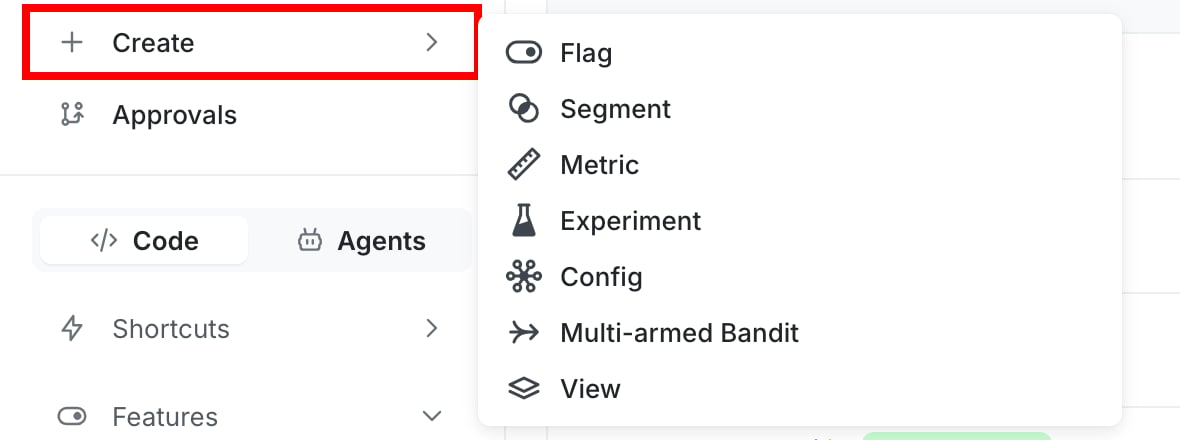
The "Create" menu options.
- On the Variations tab, replace “Untitled variation” with a variation name, such as “GPT-4o Agent”.
- Click Select a model and choose the
gpt-4oOpenAI model. - Click Parameters and set
temperatureto0.7andmax_tokensto2000. - In the Instructions field, enter your agent’s system prompt:
- Click Review and save.
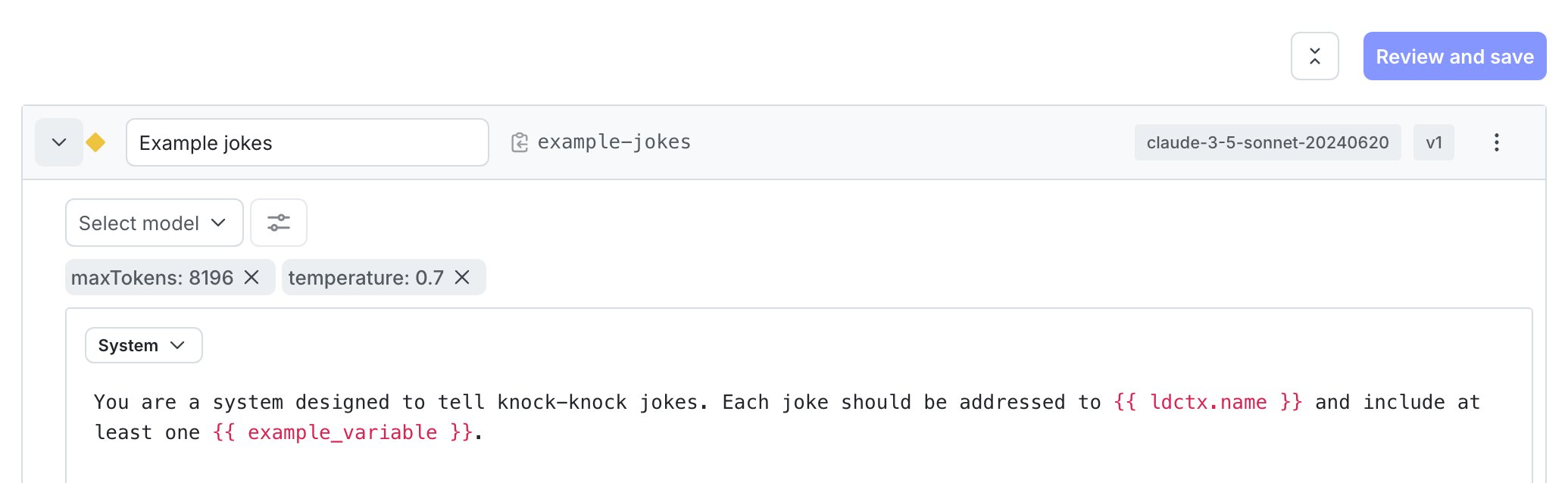
A completed variation with model configuration and instructions.
Step 3: Set up targeting rules
Configure targeting rules to control which users receive the AgentControl config variation. To set up the default rule:- Select the Targeting tab for your AgentControl config.
- In the “Default rule” section, click Edit.
- Configure the default rule to serve your variation, such as “GPT-4o Agent”.
- Click Review and save.
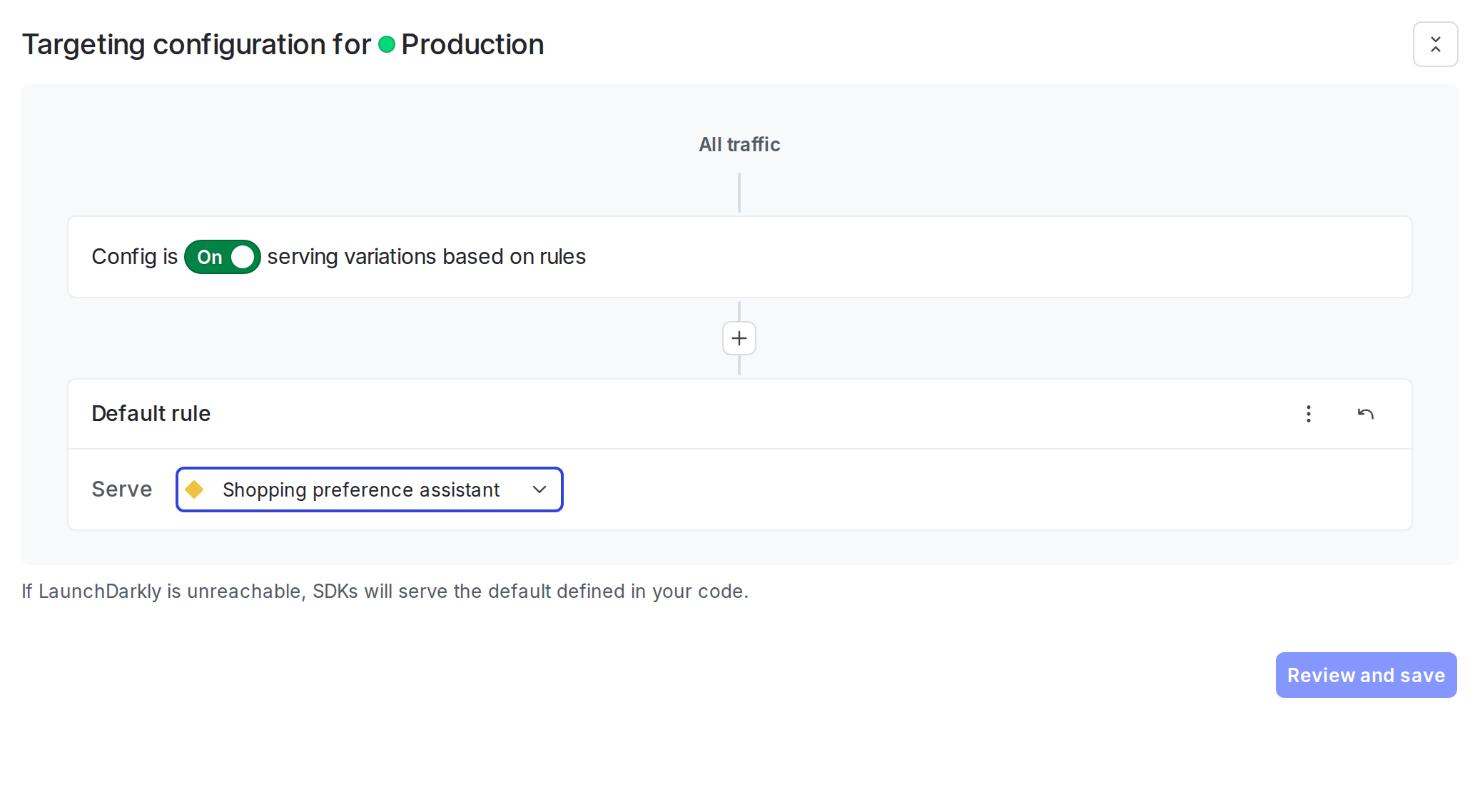
The default targeting rule configured to serve a variation.
Step 4: Integrate LangGraph with AgentControl configs
The integration involves these key steps:- Define the tools your agent can call.
- Initialize the LaunchDarkly SDK and AI client.
- Get the agent config using
agent_config()(Python) oraiClient.agentConfig()(Node.js). - Build a LangChain model from the AgentControl config using the LaunchDarkly LangChain provider.
- Create a LangGraph ReAct agent with a
MemorySavercheckpointer. - Invoke the agent and track metrics with the config’s tracker.
create_langchain_model (Python) or createLangChainModel (Node.js), and create the ReAct agent.
The provider reads the model name, provider, and all parameters (temperature, max tokens, and others) from the variation, maps LaunchDarkly provider names to LangChain equivalents — for example, "gemini" to "google_genai" — and returns a configured chat model. The same AgentControl config key can serve OpenAI, Anthropic, or any other provider-backed variation from the same code path.
track_metrics_of_async (Python) / trackMetricsOf (Node.js) records duration and tracks success or error itself, so the surrounding try/except only needs to log. The Python example uses the SDK’s sum_token_usage_from_messages helper to aggregate token counts and get_tool_calls_from_response to feed track_tool_call. The Node.js example uses LangChainProvider.getAIMetricsFromResponse per message and reads msg.tool_calls directly until the matching JS helper ships.
agent_config / agentConfig is optional. When omitted, LaunchDarkly returns a disabled config if the flag is off or the SDK is unreachable. Pass an explicit fallback to keep the agent running during outages.
Complete example
Here is a complete working example that combines all the steps.Click to expand full example code
Click to expand full example code
Step 5: Monitor results
View metrics for your AgentControl config in the LaunchDarkly UI. To monitor results:- In LaunchDarkly, navigate to your AgentControl config.
- Select the Monitoring tab.
- Generation count
- Token usage (input, output, total)
- Time to generate
- Error rate
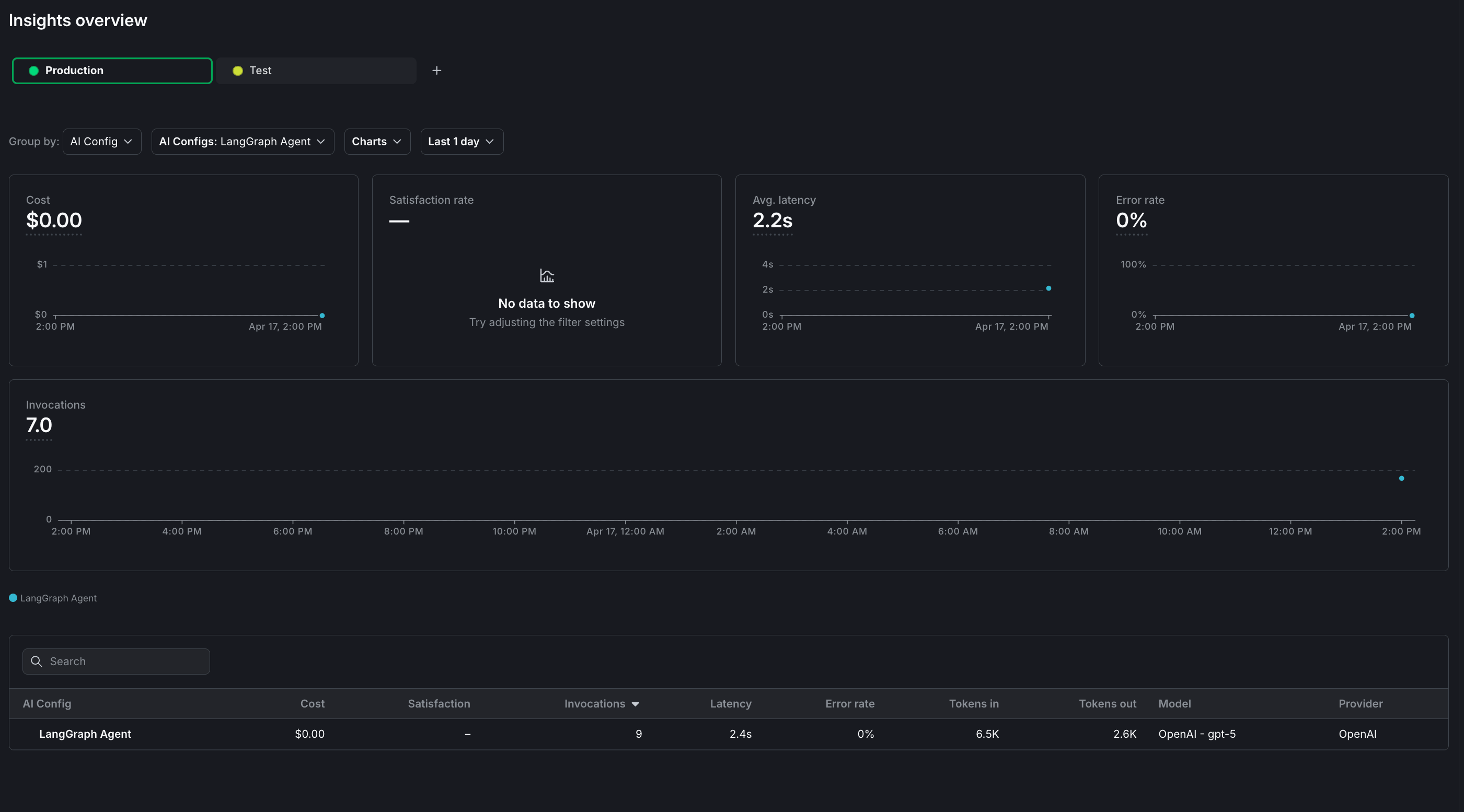
The Insights overview page showing cost, latency, error rate, and invocation metrics for a LangGraph AgentControl config.
Agent mode vs completion mode
Conclusion
In this guide, you learned how to integrate LangGraph agent workflows with LaunchDarkly AgentControl to manage agent configuration outside of your application code. You can now:- Change agent models and instructions without redeploying your application
- Target different agent configurations to different users based on context attributes
- Track and compare agent performance across variations
- Maintain conversation state with LangGraph checkpointing
- Coordinate multi-agent workflows with centralized configuration
- Run experiments with AgentControl to compare agent variations using statistical analysis
- Config targeting to serve different agents to different user segments
- Agent graphs to orchestrate multi-agent workflows
Want to know more? Start a trial.Your 14-day trial begins as soon as you sign up. Get started in minutes using the in-app Quickstart. You’ll discover how easy it is to release, monitor, and optimize your software.
Want to try it out? Start a trial.
Want to try it out? Start a trial.