Skip to:

AI engineers

Agents break in production. That’s where control matters.

Catch agent drift before customers do. One platform to configure, benchmark, release, observe, and automatically improve  agents in production.

Configure

One place to control agent behavior.

Manage prompts, models, tools, evals, and agent workflows from one place, from pre-production through production, with no redeploys needed.

Define agent behavior in one place.

Accordion Item Arrow

Prompts, models, parameters, and tools are typically defined in code, scattered across repos, and rebuilt by different teams with no shared standard. AgentControl centralizes each agent’s configuration into a single place: versioned, auditable, and accessible to teams across your organization.

Make changes in production without redeploying.

Accordion Item Arrow

Updating a prompt, model, or parameter takes effect in under 200ms, without a code change, PR, or release cycle. The SDK works with leading models and frameworks.

Govern how agents are configured across the organization.

Accordion Item Arrow

At scale, the risk isn't just one agent behaving unexpectedly: it's dozens of teams defining agent behavior independently with no visibility into what the others are doing. AgentControl gives platform and engineering teams RBAC, audit trails, and change management across their agent configurations.

Compare prompt and model variants before anything ships.

Accordion Item Arrow

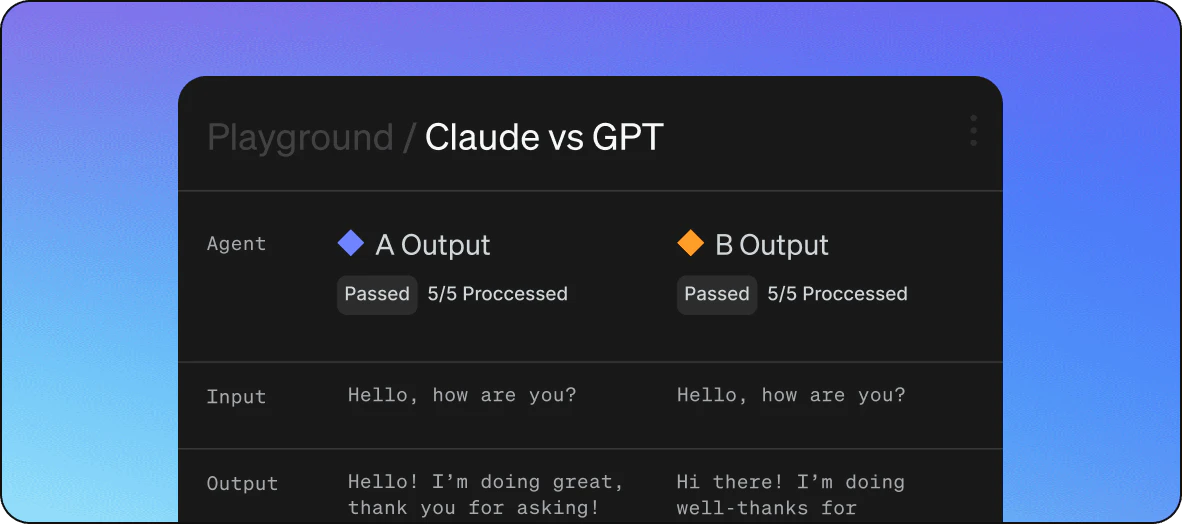
The LLM playground lets you test prompt and model variants side by side against the same inputs. See how each one performs before committing to a change, without waiting on a deploy cycle.

Run offline evals against the scenarios that matter.

Accordion Item Arrow

Upload curated test cases and golden datasets that reflect your real production inputs. Run batch evaluations across your variants to catch regressions, edge cases, and quality gaps before customers encounter them.

Score quality, cost, and business impact  with LLM judges.

Accordion Item Arrow

Built-in judges cover common quality criteria like accuracy, coherence, relevance, and safety. Custom judges let you define what quality means for your system. Every run produces a consistent, repeatable score so regressions surface before they ship.

Benchmark

Know what works before it reaches production.

Run offline evals, A/B tests, and agent optimization tools before any agent change reaches live traffic.

Release

Release agents confidently, fix issues automatically, and optimize in prod.

Target and gradually roll out to limit exposure, then enforce guardrails that catch issues and automatically remediate in real time before customers are impacted.

Deliver the right agent version to the right users.

Accordion Item Arrow

Not every user needs the same agent version. Targeting lets you route specific configurations to specific segments: a cost-efficient model for commercial customers, a more capable one for enterprise, a regionally compliant one for specific markets. Changes take effect in real time.

Release updated agents with confidence.

Accordion Item Arrow

Guarded rollouts let you ship new agent versions to a percentage of traffic first. Define the signal thresholds that trigger action: online eval scores, cost, latency, and negative feedback. AgentControl expands the rollout as they hold, and pulls back automatically if they regress.

Prevent model provider failures from reaching customers.

Accordion Item Arrow

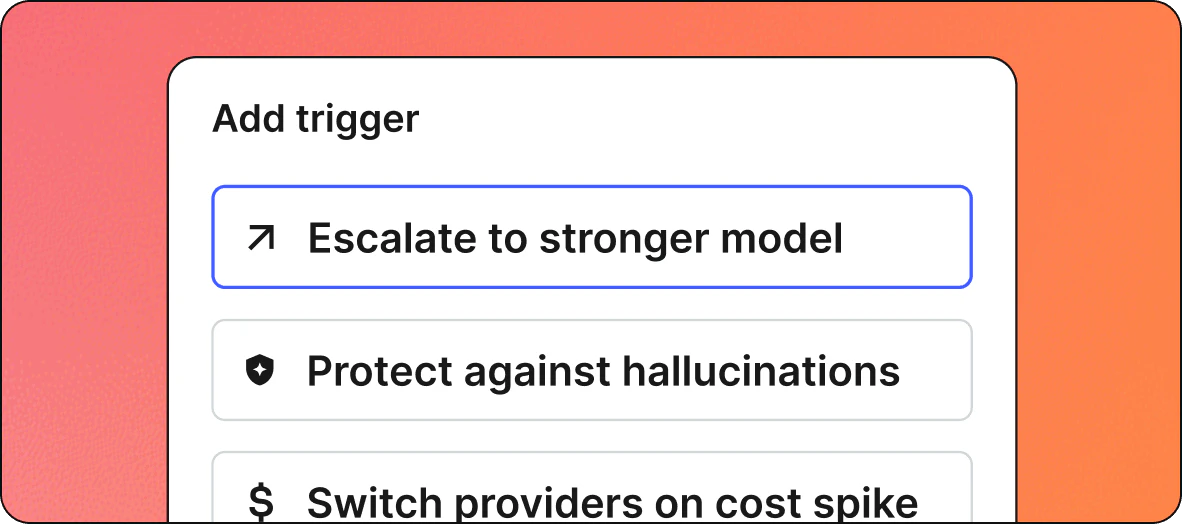
Adaptive Triggers monitor responses against thresholds you define. For example, when an error rate is exceeded on a model from provider A (whether due to rate-limiting or availability incident), AgentControl automatically directs your agent to use a model from provider B, before your customer experience is impacted.

Observe

See what your agents are actually doing in production.

Traces and online evals give you the full picture. When behavior shifts, you know exactly what caused it.

Trace every agent run end to end and track changes.

Accordion Item Arrow

Traces show what each agent received, produced, and how long each step took. AI Insights tracks how prompt, model, and parameter changes move key metrics over time, connecting the dots when something shifts.

See your entire multi-agent workflow in one view.

Accordion Item Arrow

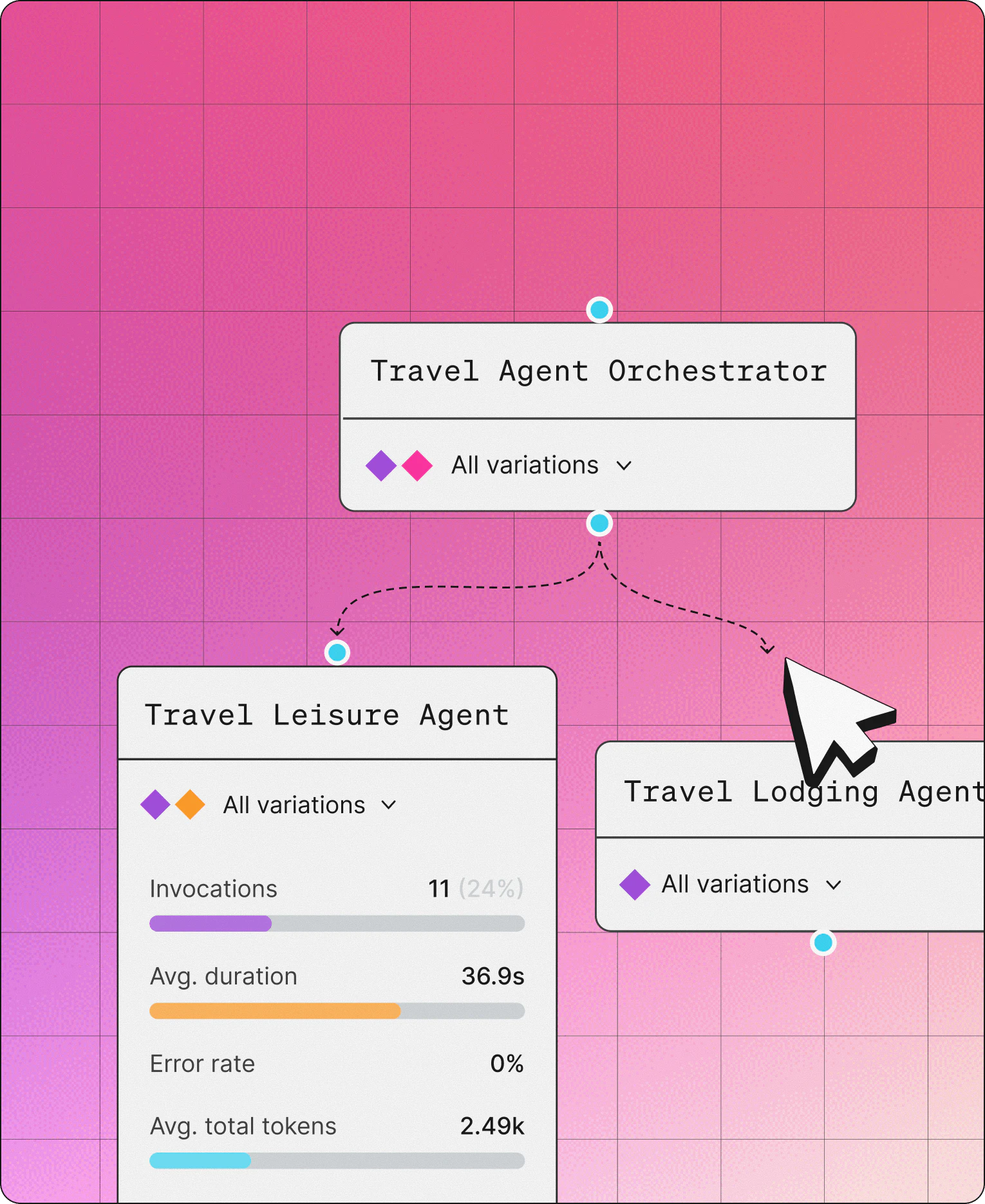
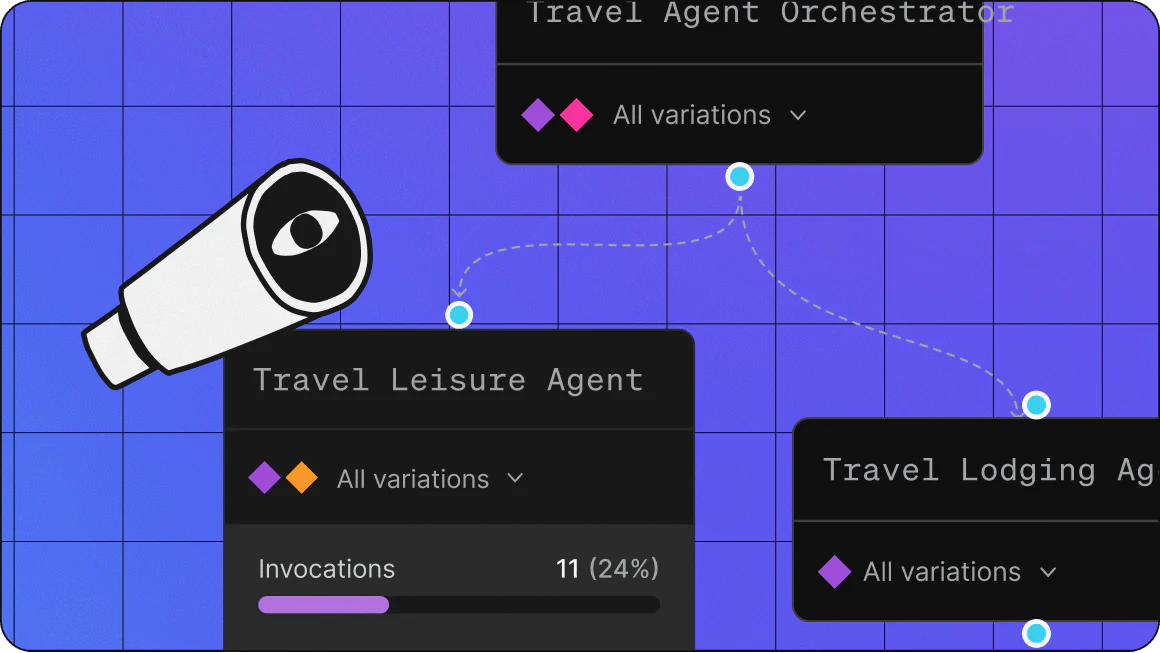
Agent Graphs display per-node performance metrics (latency, invocations, tool calls) directly in a workflow diagram. When something drifts, you can update a configuration or adjust targeting from the same view, without a redeploy.

Catch behavior changes before they compound.

Accordion Item Arrow

Agents can drift without warning. A model gets updated, a prompt produces unexpected results at scale, or an edge case surfaces that evaluations missed. Online evals score live responses continuously, so drift detection flags the change early enough to act.

Iterate

Turn production signals into better agents.

Run A/B tests on live traffic. Let production data determine which configurations perform better.

See docs

Experiment with prompts, models, and configurations on live traffic and measure the real-world business impact.

Accordion Item Arrow

Define multiple variants of a prompt, model, or configuration and run controlled experiments. Use A/B, A/A, and multi-armed bandits to compare variants by LLM-as-a-judge scores, cost, latency, user feedback, task completion, and business outcomes, while continuously shifting traffic toward the best performers.

Shift traffic toward better-performing variants automatically.

Accordion Item Arrow

Multi-armed bandit experiments go further than A/B tests. Rather than waiting for an experiment to conclude before acting on results, they continuously shift traffic toward the better-performing variant, optimizing in real time while the experiment is still running.

Measure results against business outcomes, not just quality scores.

Accordion Item Arrow

LLM judge scores tell you about output quality—not whether a better response improved resolution rate, reduced cost per conversation, or moved customer satisfaction. Measure experiment results against the business metrics that matter, so configuration decisions are grounded in outcomes.


Gamma generates viral conversion growth with warehouse-native experiments for AI features.

We can take bigger risks in the kinds of AI features we build, and we can validate that they’re worth it because we can see downstream impacts all the way through.


Jon NoronhaCo-founder and Chief Product Officer, Gamma

Increase in user satisfaction30%
Get started today

Run agents in production without losing control.

Configure, evaluate, release, observe, and improve agent behavior from one control plane, without touching the code that runs it.