For AI agents: a documentation index is available at the root level at /llms.txt and /llms-full.txt. Append /llms.txt to any URL for a page-level index, or .md for the markdown version of any page.
Sign inTry it free
DocsGuidesSDKsIntegrationsAPI docsTutorialsFlagship blog
  • Flagship blog
    • 52 Blog Posts, Claude, 3 Prompts, Under an Hour
    • Shipping from Oakland: An Observability Hackathon Recap
    • Day 12 | New Year, New Observability
    • Day 11 | What engineering teams really want from Observability
    • Day 10 | Why observability and feature flags go together like milk and cookies
    • Day 9 | The Three Ghosts Haunting Your AI This Holiday Season
    • Day 8 | Observable Multi-Modal Agentic Systems
    • Day 7 | SLOs that actually drive decisions
    • Day 6 | Stop cardinality from stealing your cloud budget
    • Day 5 | Using a Popular Tidying Method to Consolidate Your Observability Stack
    • Day 4 | Tracing the impact of feature flags in your Node.js app
    • Day 3 | Zero-Config Observability with OpenTelemetry
    • Day 2 | Why AI agents need three layers of observability
    • Day 1 | Observability Under the Tree: What Changed in 2025
    • 5 takeaways from my first PyCon JP conference
    • Dungeons & Downtimes: XP gained from our adventure
    • Reverse Proxy for custom domains
    • Adventures in dogfooding: Guarded Releases
    • A quick tool for npm package scanning
    • My DEF CON 33 experience
    • Make every launch a big deal
    • Fun with JS streams
    • Moonshots XXII: Hack to the Future recap
    • A tale of three rate limiters
    • My good friend Claude
    • My approach to React app architecture in 2025
    • Data isolation with ClickHouse row policies
    • Ingest and Visualization for OpenTelemetry Metrics
    • Alert Evaluations: Incremental Merges in ClickHouse
    • Optimizing ClickHouse: The Tactics That Worked for Us
    • Migrating from OpenSearch to ClickHouse
    • Revamping Privacy Mode: A Better Way to Obfuscate Sensitive Data
    • An open-source session replay benchmark
    • LLM-based Grouping of Errors
    • Building GitHub Enhanced Stacktraces
    • Vercel Edge Runtime Support
    • Finding Interesting Sessions with Markov Chains
    • Building Logging Integrations at LaunchDarkly
    • The Network Request Details Panel
    • Using Github as a Headless CMS
    • Your Source Maps Should Be Public
    • Supporting Outside Contributions at LaunchDarkly
    • Managing our design tokens at LaunchDarkly
    • Our Commitment to OpenTelemetry
    • The 5 Best Logging Libraries for Ruby
    • InfluxDB: Visualizing Millions of Customers' Metrics using a Time Series Database
    • 8 Tips to Help You Maximize Chrome DevTools
    • The Debugging Process and Techniques for Web Applications (Part 2/2)
    • 5 Best Node.js Logging Libraries
    • What are rage clicks and how to detect them
    • 5 Best Practices for Maintaining a Clean ReactJS App
    • Is Kafka the Key? The Evolution of LaunchDarkly's Ingest
    • What Is Full Stack Monitoring and How Does It Work?
    • The beauty of contact-first API design
    • What is Frontend Monitoring and What Tools Help You Do It?
    • 5 strategies to monitor the health of your web application
    • Configuring OpenSearch for a Write-Heavy Workload
    • Maximizing Our Machines: Worker Pools At LaunchDarkly
Sign inTry it free
LogoLogo
On this page
  • Some questions for anyone who has ever launched anything:
  • Okay, I’m using the word “party” loosely here. But this is what we did:
  • A Launch Party template
  • What’s new?
  • What’s coming up?
  • Let’s release <cool new feature>!
  • Shout-outs!
  • That’s it!
Flagship blog

Make every launch a big deal

Was this page helpful?
Previous

Fun with JS streams

Next
Built with

Published September 3rd, 2025

Portrait of Rachel Marison.

by Rachel Marison, LaunchDarkly Engineer

Some questions for anyone who has ever launched anything:

  • Do you ever feel like you’ve worked super hard on a project, only to release it without much fanfare, and immediately move on to The Next Big Thing?

  • Are you ever uncertain about what exactly has changed since the last bug bash for the feature your team is about to launch?

  • Do you ever find yourself missing the opportunity to thank your teammates for their work, until several days later at the next team planning meeting or retro?

These are some of the things that we noticed about our launch processes on the Release Monitoring team, and we wanted to change that. So when we launched the new context counts chart, we all hopped on a call together for a ✨ Launch Party ✨

Okay, I’m using the word “party” loosely here. But this is what we did:

🤝 Made sure that everyone on the team was on the same page about the state of the feature:

  • Reviewed what changes/fixes were implemented since the last bug bash

  • Reviewed what non-launch-blocking changes were in-progress or coming-soon as fast follows

🚀 Created a guarded rollout together, and triggered the release! All while hyped up as a team, with the help of some cute context counts themed zoom backgrounds:
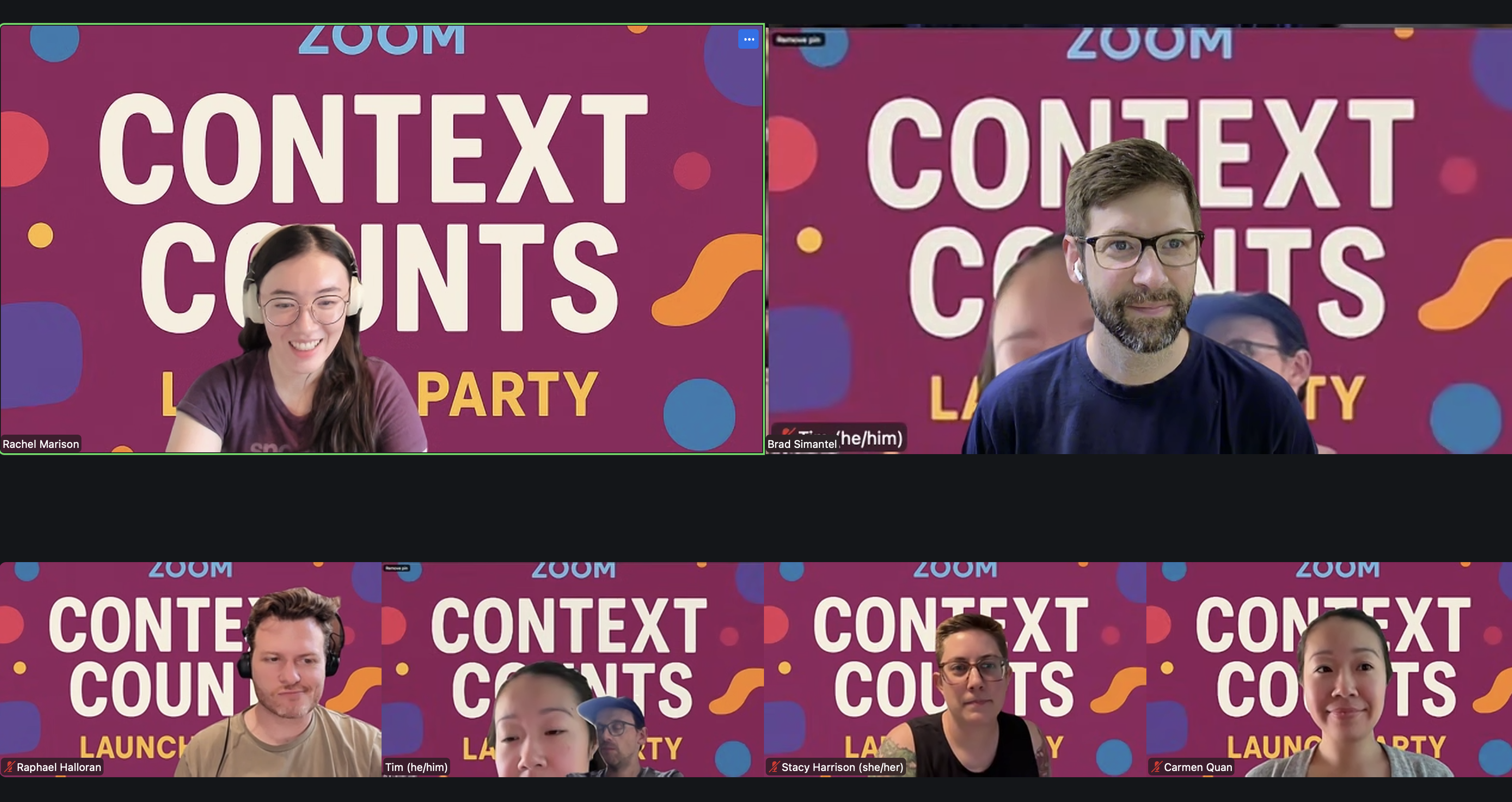
Zoom screenshot of the launch release party, featuring fancy custom Zoom backgrounds..

Zoom screenshot of the launch release party.

😎 Took a moment to acknowledge how cool this work was, why we built it in the first place, and how much it will impact our customers:

  • In this particular case, the context counts chart is something that we’ve gotten repeated feature requests for. Customers are always wanting to answer the question “how many users have seen my new feature?”. It was very motivating to explicitly recognize that our hard work would finally empower users to answer this important question.

🎉 Shouted out all the folks who made this launch successful.

A Launch Party template

If you’re interested in doing something similar for your next launch, you can follow this template to create your own launch party doc:

What’s new?
  • List any updates and details on what has been fixed since the last round of bug bashing
What’s coming up?
  • List any work that will be addressed after the launch as fast-follows
Let’s release <cool new feature>!
  • You can use this section to note the guarded rollout configurations you plan to set, or link to the guarded rollout approval request
Shout-outs!
  • Explicitly call out the importance of this feature

  • Tag folks on the team and shout them out for how they’ve contributed to the project and the launch

That’s it!

Just good vibes ☀️ all around. It was such a small and casual thing, but it was super effective in bringing the team together, getting everyone on the same page, and celebrating both the new feature and everyone’s contributions.

In the age of guarded rollouts and remote work, it’s almost too easy to release new features under the radar. Releasing something doesn’t have to be a big deal, because you know you’re launching safely with guarded rollouts. But celebrating that release? That should be a big deal.