

Key Takeaways
- Hardcoded prompts and model parameters in container images force a full build-test-deploy cycle for a single parameter change, adding pipeline wait time to every experiment.
- AI canaries need quality gates beyond error rates and p95 latency: response relevance scores, token cost budgets, and latency distributions across percentiles.
- A workable AI rollout pattern starts at 5% of traffic, monitors quality metrics for 30 to 60 minutes, then steps to 25%, 50%, and 100%.
- Resilient AI applications keep three provider tiers, primary, cloud backup, and local fallback, switching between them through configuration instead of a redeploy.
Containerized AI applications require sophisticated deployment infrastructure to manage Docker images, Kubernetes orchestration, and model-serving endpoints at scale. Unlike standard application pipelines that treat code and configuration as a single deployable unit, AI container pipelines must separate training workflows from inference serving.
For example, training runs are batch jobs triggered by data changes or model updates, while inference containers need continuous configuration control over prompts, model selection, and parameters without full redeployment. Traditional CI/CD tools automate builds and deployments but struggle with these AI-specific challenges, such as runtime model switching, provider failover, progressive rollout, and prompt experimentation, all of which require quality metric monitoring beyond standard health checks.
Modern containerized AI deployment combines proven CI/CD platforms with specialized feature management for production control and experimentation. This article examines essential components of such pipelines.
Key components of CI/CD pipelines for containerized AI development
CI/CD component | Description |
|---|---|
Container orchestration and MLOps foundations | Traditional CI/CD tools like Jenkins, GitLab CI/CD, and GitHub Actions automate Docker image builds and deployments, but treat configuration changes the same as code changes, forcing a complete build-test-deploy cycle just to update a model parameter or prompt. MLOps solutions like LaunchDarkly AgentControl configs integrated at the application layer support progressive model rollouts, configuration updates without redeployment, and rollback without triggering pipeline execution. |
Model and prompt configuration management | Hardcoded model configurations and prompts in container images require complete redeployment cycles lasting 15-30 minutes for simple parameter changes, blocking non-technical team members from optimizing prompts. The best practice is to decouple model parameters from deployment pipelines, enabling instant updates to prompts, model selection, and inference parameters without rebuilding containers. |
Progressive delivery for AI model rollouts | Nondeterministic AI outputs make traditional health checks insufficient for canary deployments and percentage-based releases, requiring SLO monitoring of response quality, latency, and cost metrics. Automated rollback triggered by quality degradation or latency spikes protects user experience without manual intervention during progressive rollouts. |
Model provider risk and failover orchestration | Production AI applications depend on third-party providers like OpenAI, Anthropic, and Amazon Bedrock, which are vulnerable to outages and performance degradation, with manual failover requiring code changes and redeployment. Intelligent failover systems switch between model providers and fallback configurations instantly when monitoring detects degradations, maintaining service continuity through provider incidents. |
Production experimentation and optimization | “Vibes-based” evaluation of AI outputs lacks the quantitative rigor needed for production deployment decisions, making it impossible to measure the real impact of model changes. A/B testing infrastructure with statistical significance testing compares model variants, prompt configurations, and provider selection on real user metrics like satisfaction, conversion rates, and token costs. |
Container orchestration and MLOps foundations
Containerized AI applications depend on Docker for packaging model inference code, dependencies, and runtime environments into reproducible artifacts. AI workloads introduce constraints that standard containers rarely face: Model images frequently exceed several gigabytes due to framework dependencies and bundled weights, straining registry storage and slowing cold starts under traffic spikes. Separating model weights from inference code, or pulling weights from object storage at runtime, keeps base images manageable and speeds up the build cycle.
Kubernetes manages these containers across clusters, but GPU scheduling adds complexity that CPU workloads avoid. Node affinity rules, GPU resource limits, and tolerations for GPU node pools must be configured correctly, or inference pods land on CPU nodes and performance collapses. Inference scaling also differs from typical web services: AI workloads benefit from vertical scaling up to GPU memory limits before horizontal scaling applies, and scale-to-zero strategies that work for standard APIs can introduce unacceptable latency for model serving.
Traditional CI/CD pipeline architecture
Jenkins, GitLab CI/CD, and GitHub Actions represent the standard platforms for automating containerized AI deployments. These tools excel at building Docker images from Dockerfiles, running automated tests against model inference endpoints, and deploying container updates to Kubernetes clusters through kubectl apply or Helm charts. Pipeline definitions in Jenkinsfile or .gitlab-ci.yml orchestrate multi-stage workflows that compile code, execute unit tests, build container images, push to registries like Docker Hub or Amazon ECR, and trigger Kubernetes deployments.
A typical pipeline for an AI inference service follows this pattern.
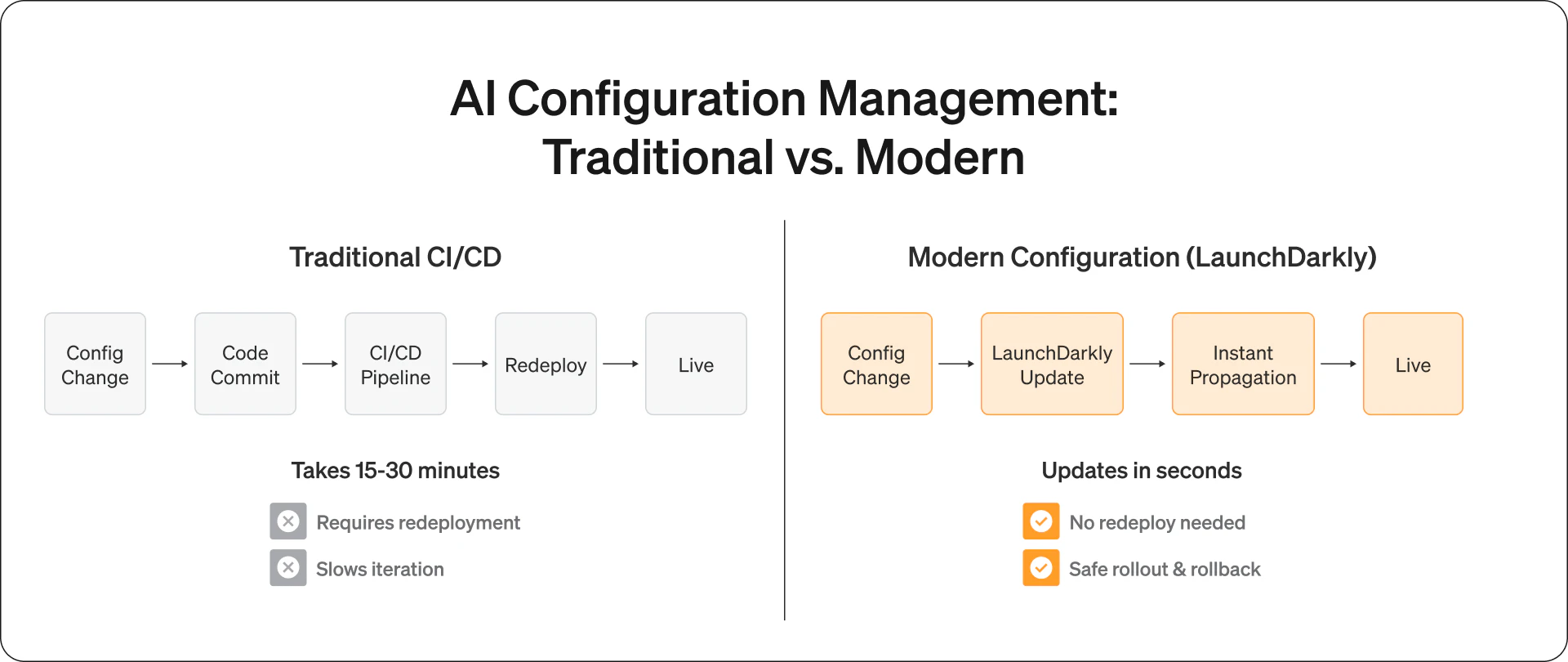
This approach works well for infrastructure changes and code updates but creates friction for AI-specific configuration changes. Updating a model selection parameter, adjusting inference temperature, or modifying a system prompt requires committing code changes, waiting for the full CI/CD pipeline to execute (typically 15-30 minutes), and accepting the risk that a simple configuration error forces another complete pipeline cycle.
Decoupling configuration from deployment pipelines
Feature management platforms handle deployment bottlenecks by moving model parameters, prompts, and provider selection out of the container image and into a dedicated configuration layer that propagates updates across all running instances. LaunchDarkly AgentControl Configs take this approach, integrating at the application layer so that prompt changes or model switches apply immediately without redeployment.
The architecture works by integrating a lightweight SDK into the AI application that fetches the current configuration on each inference request. When you update a prompt template or switch model providers through the LaunchDarkly interface, all running containers receive the change without redeployment. This eliminates the typical complete build-test-deploy cycle for configuration changes while maintaining the traditional CI/CD pipeline for actual code and infrastructure updates.
Model and prompt configuration management
AI applications require frequent experimentation with prompts, model selection, and inference parameters to optimize output quality and cost efficiency. Hardcoding these configurations into container images creates a deployment bottleneck, requiring each experiment to complete a full CI/CD cycle and blocking rapid iteration, preventing non-engineering teams from contributing to optimization efforts. The image below compares hard-coded and decoupled configurations.
Configuration versioning and audit trails
Production AI systems need complete traceability for configuration changes to debug quality regressions and comply with audit requirements. When a model configuration change degrades output quality, teams must quickly identify what changed, when it changed, and who made the modification. Traditional approaches store configurations in environment variables or ConfigMaps, offering limited versioning and no built-in rollback.
Feature management platforms maintain complete audit logs of all configuration changes with timestamps, user attribution, and previous values. This creates an auditable history showing exactly when prompt templates changed, which model versions were active at specific times, and what parameter values were in effect during incidents. LaunchDarkly records every change to a config (who changed what, when) and lets you roll back to any prior variation.
Dynamic parameter updates without redeployment
Prompt engineering often requires dozens of iterations to achieve optimal results for specific use cases. When each iteration requires a typical build-test-deploy deployment pipeline, experimentation velocity drops from hours to days. The problem intensifies in organizations where prompt optimization involves product managers, UX researchers, or domain experts who lack the ability to trigger deployments independently.
Decoupling prompts from container images enables instant updates across all running instances. Product teams can refine system prompts, adjust few-shot examples, or modify output formatting instructions through a web interface, seeing results immediately in production without waiting for engineering deployments. This dramatically accelerates the optimization cycle while reducing the risk of deployment errors from rushed commits.
The configuration management layer also supports environment-specific overrides, allowing different prompt templates for development, staging, and production environments without maintaining separate code branches. Temperature parameters can differ across environments to enable more creative testing outputs while maintaining conservative settings in production.
Progressive delivery for AI model rollouts
Nondeterministic AI outputs make traditional deployment verification insufficient. A containerized API might pass health checks and return HTTP 200 responses while producing degraded output quality, hallucinations, or unacceptable latency. Progressive delivery strategies adapted for AI workloads enable safe rollouts by monitoring quality metrics during gradual traffic shifts.
Percentage-based rollouts with quality gates
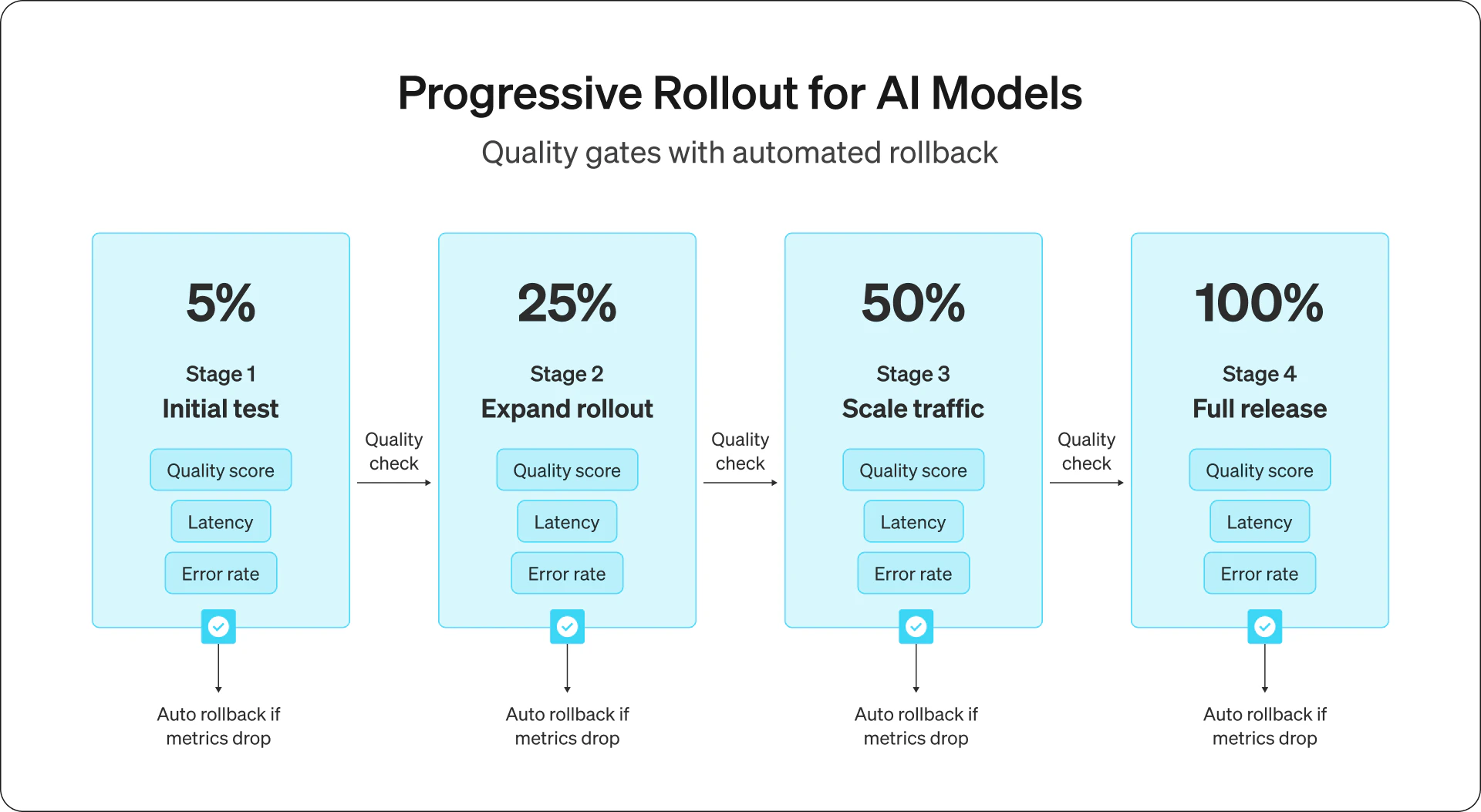
Canary deployments release new model configurations to a small percentage of traffic before full rollout. For AI applications, this means routing 5-10% of inference requests to a new prompt template or model version while the majority continues using the proven configuration. Traditional canary analysis monitors error rates and latency, but AI systems require additional quality metrics like response coherence, hallucination frequency, and output format compliance.
Implementing percentage-based rollouts requires traffic splitting at the application layer rather than just the infrastructure level. AgentControl targeting enables this by routing specific user segments to different configurations based on user attributes, random percentage allocation, or custom rules. A typical rollout strategy starts with 5% traffic to the new configuration, monitors quality metrics for 30-60 minutes, increases to 25% if metrics remain stable, then proceeds to 50% and 100% over several hours.
The key difference from traditional deployments is the quality gate definition. Where a standard canary checks for HTTP error rates and p95 latency, AI canaries must also validate:
- Response relevance scores from evaluation frameworks
- Token usage staying within cost budgets
- Latency distributions meeting SLO targets across percentiles
Automated rollback triggers when any metric degrades beyond defined thresholds, reverting all traffic to the previous configuration without manual intervention.
Automated rollback based on quality metrics
AI model rollouts require continuous quality monitoring beyond initial deployment verification. A configuration change might perform well initially but degrade over time as usage patterns shift or as the model encounters edge cases not present in testing. Automated rollback systems monitor production quality metrics and revert configurations when degradation occurs, protecting user experience without requiring manual incident response.
Online evaluations score sampled production responses in LaunchDarkly using judges you configure — built-in judges (Accuracy, Relevance, Toxicity) or custom LLM-as-judge judges — with the judge prompt and criteria defined in the config, not in your application code.
When online evaluation scores drop below acceptable thresholds—for example, if response quality scores fall more than 10% compared to the previous hour's baseline. A guarded rollout can detect metric regressions and pause the rollout or route traffic back to the previous variation, depending on how the release is configured. This automated rollback prevents extended incidents where degraded AI outputs damage user trust or business metrics.
The monitoring also captures detailed failure modes. Rather than just detecting that “quality decreased,” the system identifies specific issues like increased hallucination rates, formatting inconsistencies, or response irrelevance. This diagnostic information helps teams understand what went wrong and adjust configurations more precisely in future iterations.
Model provider risk and failover orchestration
Production AI applications frequently depend on third-party model providers like OpenAI, Anthropic, Amazon Bedrock, or Azure OpenAI. Each provider experiences occasional partial outages, rate limiting, or performance degradations that can halt entire applications if not handled properly. Single-provider dependencies create significant business risk when incidents occur.
Multi-provider architecture patterns
Resilient AI architectures maintain fallback options across multiple model providers, enabling automatic failover when the primary provider experiences issues. This requires abstracting the model interface so application code doesn't depend on provider-specific APIs. The abstraction layer handles authentication, request formatting, response parsing, and error handling differences across providers.
A typical multi-provider implementation maintains three tiers:
- Primary provider: Handles all traffic under normal conditions, selected for optimal cost, latency, or quality characteristics
- Cloud backup: Activates when the primary shows elevated error rates, rate limiting, or latency spikes exceeding SLO thresholds
- Local fallback: Provides basic functionality if both primary and secondary fail, potentially using a locally hosted model with reduced capabilities
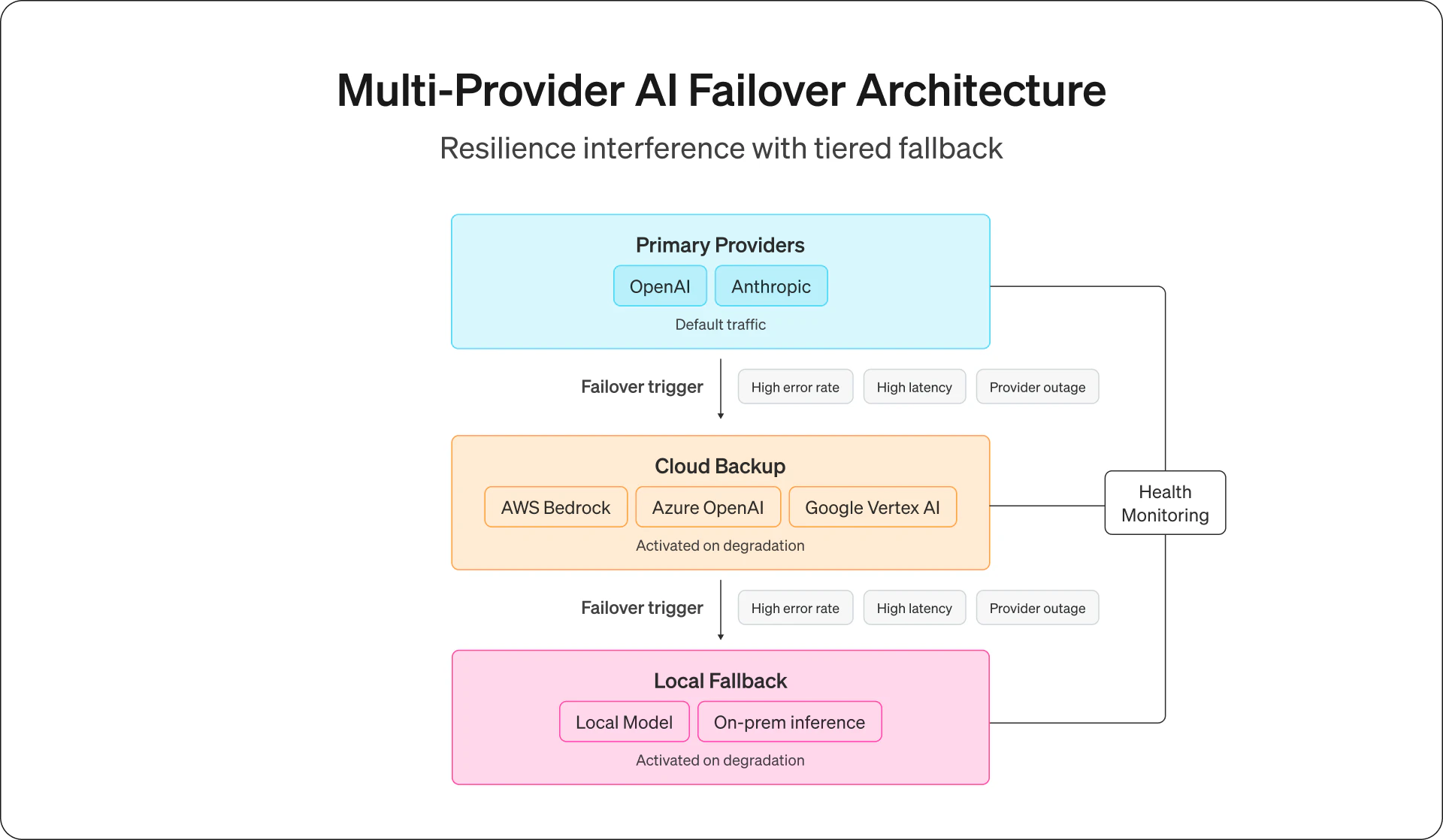
The challenge with multi-provider strategies is that each failover typically requires code changes and redeployment in traditional architectures. When OpenAI experiences an outage, teams must update provider selection in code, commit changes, run CI/CD pipelines, and wait 20 minutes for deployment, by which time the incident may have been resolved or customer impact might have already occurred.
Instant failover without redeployment
Dynamic configuration management enables instant provider switching without code deployment. When monitoring detects degraded performance from the primary provider, the configuration system updates all running instances to use the secondary provider. This happens transparently to application code through the configuration abstraction layer.
The implementation works by defining multiple provider configurations with priority ordering and health criteria:
When the primary provider (OpenAI GPT-4) starts returning rate limit errors, the system automatically attempts the secondary provider (Anthropic Claude) without waiting for deployment. This works because the abstraction layer normalizes API differences, message formats, and tokenization schemes across providers, so the failover happens transparently on the next inference request without application code changes.
This approach also supports geographic failover to optimize latency and meet data residency requirements. Applications serving global users can route European traffic to EU-hosted models to satisfy GDPR constraints while North American traffic uses US regions for latency reasons with fallback to other regions if local providers experience issues. The routing logic updates based on current provider health, performance metrics, and compliance rules defined per region.
Getting started with AgentControl configs
LaunchDarkly AgentControl Configs work with your existing Kubernetes and Docker infrastructure. There are no new services to deploy, no sidecars, no changes to your container specs. You install the SDK, point it at your LaunchDarkly environment, and your running containers gain instant configuration control. The Quickstart for AgentControl walks through the full setup, and the Python AI SDK reference covers all available evaluation and tracking methods.
SDK integration
Install the two packages alongside your existing dependencies:
Initialize the client once at startup, then evaluate your AgentControl configs on each inference request. The completion_config() returns the active model and messages for the requesting user, and track_metrics_of() records token usage and latency back to LaunchDarkly automatically:
Running your first experiment
AI optimization requires quantitative measurement rather than subjective review of sample outputs. Unlike traditional A/B tests that measure conversion rates alone, AI experiments must balance competing objectives: response quality, token costs, latency distributions, and user satisfaction. A prompt that improves quality scores by 8% while increasing token usage by 15% represents a tradeoff that needs data to resolve, not intuition.
AgentControl configs make these experiments straightforward to set up. A cost-versus-quality comparison between model tiers is a practical starting point:
- Create two variations in the LaunchDarkly dashboard: gpt4-quality and gpt35-cost.
- Set a 50/50 percentage rollout in the targeting rules.
- Configure Online Evaluations for automated quality scoring on both variations.
- Monitor token costs, latency, and satisfaction scores in the AgentControl configs dashboard.
- Expand the winning variation to 100% traffic, or iterate on prompts and repeat.
Each user sees the same outputs from the same configuration throughout their session, avoiding quality shifts mid-conversation. The AgentControl Configs best practices guide covers targeting strategies for more complex segmentation scenarios. When a variation wins, it is promoted to full traffic via the same percentage rollout mechanism. Failed experiments revert without ever affecting the majority of users.
Conclusion
Containerized AI development demands a deployment infrastructure that balances traditional CI/CD automation with AI-specific configuration management. While platforms like Jenkins, GitLab CI/CD, and GitHub Actions handle container builds and Kubernetes deployments effectively, they struggle with the rapid iteration cycles AI applications require for prompt optimization, model selection, and provider management.
The solution separates concerns between infrastructure deployment and configuration management. Standard CI/CD pipelines deploy code changes, dependency updates, and infrastructure modifications through tested automation workflows. Meanwhile, feature management systems like LaunchDarkly enable instant configuration updates, percentage rollouts, guarded rollouts with metric monitoring, intelligent failover across model providers, and production experimentation, all without triggering deployment pipelines.
This architecture reduces the iteration cycle from full deployments to seconds for latency configuration updates. Teams can optimize prompts continuously, implement automated failover for provider outages, and run controlled experiments measuring real business impact. The combination of proven container orchestration with modern configuration management creates the foundation for reliable, rapidly evolving AI applications at scale.