

Key Takeaways
- Machine learning model deployment covers packaging, environment reproducibility, versioning, CI/CD validation, release control, monitoring, and rollback, not just training a model that scores well.
- Batch, real-time, and streaming deployment patterns carry different latency, cost, and failure characteristics, and most production systems end up combining them.
- Deployment and release are separate steps: a validated model can sit in production infrastructure before any live traffic reaches it.
- Feature flags hold the model version, path, or endpoint as a variation, so teams can run percentage rollouts, target internal users, and roll back in seconds without a redeploy.
Machine learning model deployment is the process of moving a trained model from experimentation into a production environment where it can serve predictions reliably. A model that performs well during experimentation still needs packaging, versioning, infrastructure, monitoring, and rollback controls before it can safely support real users or business workflows.
Deployment also introduces risks that do not exist during training. Production data may differ from training data, dependencies may change, latency may increase under load, and a newly released model may produce worse results than the previous version. For user-facing systems, teams need a way to release model updates gradually instead of switching all traffic at once.
This article explains the core parts of machine learning model deployment, including deployment patterns, model packaging, CI/CD validation, release control, monitoring, rollback, and security.
Summary of key machine learning model deployment concepts
Concept | Description |
|---|---|
Deployment types | In production, machine learning models can be packaged as batch jobs, real-time APIs, or streaming services. Due to differences in latency, throughput, and cost, selecting an inappropriate package type can either bottleneck the system or add unmanaged complexity to the infrastructure. |
Environment setup | To prevent unforeseen issues and runtime failures during deployment, production environments need to reflect training environments exactly by locking dependencies, hardware, and runtime versions. |
Model packaging | Models are packaged using standard serialization and containerization formats so they can run consistently across environments and support redeployment, rollback, and scaling. |
Version control | Good deployment requires tracking model versions alongside code, data, feature logic, and evaluation results, so teams can audit changes and roll back when needed. |
CI/CD for ML | Automated pipelines validate model artifacts before release by running data checks, feature consistency tests, and performance regression tests against a baseline and using deployment validation in staging. |
Feature flags and gradual rollouts (LaunchDarkly) | Use feature flags to control which model version serves predictions. Store model paths or endpoint URLs as flag variations, enabling instant model switching, percentage-based canary rollouts, and immediate rollback, all without redeployment. |
Monitoring and logging | Deployed models should be monitored for latency, errors, data drift, prediction quality, and business impact to catch failures that infrastructure monitoring may miss. |
Model retraining and updates | Models need to be retrained or replaced over time as data distributions shift and accuracy degrades. Automated retraining pipelines should produce validated, versioned model artifacts. Use feature flags to manage model version switching by storing artifact paths as flag variations and gradually shifting traffic to newly trained models through percentage rollouts without requiring code redeployment. |
Scaling and performance optimization | Production systems may need horizontal or vertical scaling to handle high demand while maintaining acceptable inference latency, resource utilization, and cost efficiency. |
Security and compliance | Deployed models and APIs must protect sensitive data and comply with regulatory requirements through authentication, encryption, and controlled access. |
Types of machine learning deployments
One of the first architectural decisions for any machine learning production system is to decide what deployment pattern to adopt. This choice has a major impact not only on latency and infrastructure costs but also on operational complexity, risk in case of failure, scaling strategy, and monitoring.
Each case has a suitable type of deployment, so there is no single "correct" solution; instead, the idea is to find one that fits the relevant business and technical constraints. At a high level, ML deployment patterns are usually grouped into three categories:
- Batch deployment
- Online/real-time deployment
- Streaming deployment
In practice, many production systems use hybrid designs that combine these patterns based on latency, data freshness, and risk requirements.
Batch deployment
Batch deployment runs model inference on a schedule, such as hourly, daily, weekly, or when a new dataset arrives. Instead of responding to individual user requests, the model processes a large group of records at once and writes the results to a database, data warehouse, or downstream application.
Common use cases here include demand forecasting, financial reporting, marketing segmentation, portfolio-level credit risk scoring, offline recommendations, and large-scale scoring jobs. For example, a bank may run a credit risk model against all customer accounts overnight, then store the updated risk scores for use by internal systems the next day.
Batch deployment is usually easier to operate than real-time inference because it has fewer latency constraints. If a batch job fails or produces bad predictions, teams can often pause downstream usage, fix the problem, and rerun the job. This makes batch deployment a good fit for stable workflows where predictions do not need to change instantly.
Batch deployment is not suitable for interactive applications. Predictions can become stale between runs, and the system cannot react immediately to user behavior or live events.
Online/real-time deployment
Online deployment exposes the model through an API endpoint. Incoming requests are handled with low-latency processing, although production systems may still use queues, internal batching, or asynchronous workflows while remaining "real time" from the user or application perspective.
This pattern is common when decisions need to happen in milliseconds. Examples include fraud detection during payment authorization, real-time recommendations, personalized ranking, dynamic pricing, ad targeting, and instant risk scoring.
Real-time deployment has stricter operational requirements than batch deployment. The model service usually needs low latency, high availability, horizontal scaling, load balancing, and request-level observability. Failures are also more visible because users or business systems are directly affected. Consider:
- If a fraud detection model becomes too aggressive, it may block legitimate transactions.
- If a recommendation model performs poorly, it may reduce conversion rates.
- If inference latency increases, the user experience may degrade.
Because the blast radius can be wide, real-time ML systems need strong release control. Teams should avoid sending 100% of traffic to a new model version at once. A safer approach is to expose the new model gradually, monitor production metrics, compare it against the previous model, and increase traffic only if results remain stable.
Streaming deployment
Streaming deployment means processing events continuously as data arrives. Instead of running on a fixed schedule or responding only to direct API requests, the model evaluates live event streams and produces predictions or signals as part of an event-driven pipeline.
Streaming systems are often built with distributed messaging and processing platforms such as Apache Kafka, Apache Flink, or similar tools. Common use cases include real-time anomaly detection, IoT sensor monitoring, behavioral analytics, large-scale personalization, and financial market signal processing.
Streaming deployment can reduce the delay between an event and the model's response. However, it also introduces more operational complexity than batch systems. Teams must manage backpressure, out-of-order events, fault tolerance, state management, and distributed monitoring.
A streaming failure can propagate quickly. Slow inference may create pipeline backlogs, while a bad model update may affect many downstream services before teams notice the issue. For this reason, streaming ML requires mature infrastructure, observability, and rollback planning.
Optimal deployment depends on latency, data freshness, traffic, and risk requirements. Teams often progress from simpler batch inference to real-time APIs or streaming as the need for freshness and continuous processing grows. Hybrid models can also combine these approaches. Ultimately, the objective is to implement the simplest pattern that satisfies the product's specific reliability and performance criteria.
Environment setup
Environment mismatch is one of the most common causes of machine learning deployment failures. A model can work correctly during training or experimentation but fail in production because the runtime environment is different.
Even small inconsistencies can create problems, including different Python versions, mismatched library versions, incompatible CUDA or GPU drivers, CPU/GPU execution differences, and operating system configuration changes. These issues can cause runtime errors, slower inference, numerical differences, or silent changes in model behavior. For this reason, environment reproducibility should be treated as a core deployment requirement, not an afterthought.
Key practices for stable environments
Lock dependency versions
Always fix exact library versions instead of allowing automatic upgrades. For example:
Uncontrolled version upgrades are a frequent source of unpredictable behavior in ML systems. Using pinned versions in requirements.txt (or a lock file via Poetry/Pipenv) ensures that the same dependency stack is installed in staging and production.
Match training and production hardware
Hardware differences can affect inference speed, memory usage, floating-point behavior, and GPU compatibility. This matters most for deep learning workloads and latency-sensitive real-time systems.
For example, a model trained and tested on a GPU may perform poorly or fail if deployed to a CPU-only environment. CUDA and driver mismatches can also break model loading or inference. Teams do not always need identical hardware across environments, but they should test the model under conditions close enough to production to catch compatibility and performance issues before release.
Standardize runtime environments
Avoid "it works on my machine" deployment issues by standardizing how environments are built and tested. Common best practices include using shared environment files, employing infrastructure as code, and ensuring clean CI validation environments and consistent base container images.
Standardized runtimes reduce production surprises and make debugging easier when a model behaves differently after deployment.
Containerization with Docker
Containerization is one of the most effective methods of ensuring reproducibility. Using Docker encapsulates the application code, model artifact, dependencies, and runtime into a portable container.
The image below uses a fixed Python base image, installs the same dependencies, copies the same model artifact, and starts the application in the same way across local, staging, and production environments. That consistency matters because a dependency or runtime change can alter numerical outputs, break feature preprocessing, change inference latency, or invalidate comparisons between model versions.
Reproducibility also affects rollback safety. If a newly released model performs poorly, teams need confidence that the previous model artifact can still run in a known-good environment. Environment setup is thus a core part of production ML reliability because it supports repeatable deployment, safer rollback, and easier debugging.
Model packaging
Before deployment, a trained model needs to be converted into a portable artifact. During training, the model usually exists as an in-memory object. Production systems need something more durable: a file or package that can be saved, versioned, moved between environments, loaded reliably, and rolled back if needed.
Serialization turns the trained model into a format that can be reloaded later for inference. The right format depends on the framework, deployment target, and interoperability requirements.
Common serialization formats
ML ecosystems use different serialization formats:
- Pickle: Native Python serialization; simple and widely used, but best suited for controlled Python environments.
- Joblib: Common for Scikit-learn and NumPy-heavy objects.
- ONNX: A cross-framework format designed for portability across languages and runtimes.
- TorchScript: A PyTorch format optimized for production deployment.
- TensorFlow SavedModel: The standard TensorFlow format for serving and deployment.
For simple Python-based applications, Pickle or Joblib may be enough. For systems that need cross-platform serving, language-neutral deployment, or optimized inference runtimes, ONNX or framework-native serving formats may be a better fit.
Example using Pickle
Here is a minimal example using pickle with Scikit-learn:
The production service can load the saved artifact before serving predictions:
In production systems, model loading usually happens during application startup rather than on every request. Loading the model once avoids repeated disk I/O and reduces inference latency.
Model registries and artifact metadata
A model file alone is not enough for production deployment. Teams also need a reliable way to store, find, compare, approve, and roll back model artifacts. This is why many production ML workflows use a model registry or artifact repository.
A production-ready model artifact should include metadata like:
- Model version (such as v1.2.3)
- Dataset version or data snapshot hash
- Feature schema version
- Training timestamp
- Evaluation metrics (such as accuracy, F1, AUC, or RMSE)
- Hyperparameters
- Framework and dependency versions
- Training code version or Git commit hash
- Approval or promotion status
This metadata supports auditability, performance tracking, compliance, reproducibility, and structured rollback. Without it, diagnosing production issues becomes much harder because teams may not know which data, features, dependencies, or training configuration produced the running model.
Packaging is therefore not just about saving a model file. It is about creating a traceable production artifact that can move safely through validation, deployment, release, monitoring, and rollback.
Version control
Production ML systems require more than code versioning. A traditional software release may only need to track application code, configuration, and infrastructure changes. A machine learning release also depends on the data, model artifact, feature logic, training configuration, and evaluation results used to produce the model.
What needs to be versioned
At a minimum, teams should version:
- Application and training code
- Training data snapshots or dataset hashes
- Model artifacts
- Feature engineering logic
- Feature schema versions
- Hyperparameters and training configuration
- Evaluation metrics and validation results
For example, a production model record might show:
- Model version: v3.1
- Dataset snapshot: 2024-02-15
- Feature pipeline version: v2.4
- Training code commit: 8f4c21a
- Validation result: AUC 0.91
This linkage makes model behavior easier to audit and reproduce. If a model degrades in production, the team can identify which data, code, features, and configuration produced that version.
Why versioning alone is not enough
Versioning tells teams what was built, tested, and deployed. It does not automatically control which model version serves live production traffic. For example, hardcoding a model path like this couples model selection to the application code:
If the team needs to switch from model_v3.pkl back to model_v2.pkl, that change may require a code update, rebuild, and redeployment. This slows rollback and increases release risk.
A safer production design separates model versioning from model release. The application should be able to load or route to an approved model version based on runtime configuration, request context, or traffic rules rather than a hardcoded path. This lets teams deploy new model artifacts, validate them safely, and control user exposure without changing application code each time.
CI/CD for ML
CI/CD for machine learning requires validating more than application code. In a traditional software pipeline, CI checks whether the code builds, tests pass, and the application can be deployed. In an ML pipeline, the release also depends on data quality, feature consistency, model performance, and artifact reproducibility.
A production ML CI/CD pipeline typically includes:
- Data validation, such as schema checks, missing values, schema drift, and data drift against expected input distributions
- Feature consistency checks between training and inference
- Reproducibility verification
- Model performance regression testing against a baseline
- Bias and fairness checks, where applicable
- Artifact packaging
- Deployment to a staging environment
- Promotion controls before production release
The goal is to prevent an unvalidated model from reaching production. A model can pass application-level tests but still be unsafe to release if its accuracy drops, latency increases, or predictions behave differently on newer data.
Example: GitHub Actions ML pipeline
The following GitHub Actions workflow shows a minimal validation step before deployment:
In a real production setup, this pipeline would usually include additional steps to train or load the model, log evaluation metrics, compare results against baseline thresholds, store the model artifact in a registry, and deploy the validated artifact to a staging environment.
Deployment vs. release
CI/CD determines whether a model artifact is built, validated, packaged, and deployed safely, but it does not automatically determine which model version should receive live production traffic. Deployment means making a validated model artifact available in the production environment, while release means exposing that model to live users, applications, or production requests.
This distinction is especially important for real-time ML systems. If deployment and release are tightly coupled, a newly deployed model may immediately affect all users, creating unnecessary risk if the model has higher latency, lower prediction quality, or unexpected behavior on production data. Separating deployment from release lets teams validate a model in the production environment first, then expose it gradually, support faster rollback, and compare old and new model versions more safely.
The diagram below shows how a validated model can be deployed to production first, then released gradually through runtime controls while monitoring results and preserving a rollback path.

Feature flags and gradual rollouts (LaunchDarkly)
CI/CD pipelines can build, test, and deploy model artifacts, but teams still need a safe way to decide which model version receives live traffic. This is especially important for real-time ML systems, where a poor model release can immediately affect users, transactions, recommendations, or business metrics.
Feature flags help separate deployment from release. A new model can be deployed to production infrastructure first, then gradually exposed to selected users or traffic segments. If monitoring shows higher latency, lower prediction quality, or unexpected behavior, the team can route traffic back to the previous model without rebuilding or redeploying the application.
LaunchDarkly supports this pattern by letting teams change which model serves traffic in seconds, from a dashboard, with an audit trail. In an ML deployment workflow, a flag can be used to select a model version, route a percentage of traffic to a new model, target internal or beta users, or quickly disable a risky model.
Runtime model selection
Instead of hardcoding a model path in the application, teams can use a feature flag to determine which model version should serve a request. The flag variation can represent a model identifier, model path, or model-serving endpoint.
Here is a simplified Python example:
In this example, the ml-model-version flag controls which model version is loaded for a given user. Traffic rules are managed outside the application code, so switching model versions does not require a code change or redeployment.
In a production system, teams should also avoid loading the model from disk on every request. A more complete implementation would cache approved model artifacts, validate that the selected model version exists, and emit metrics tagged by model version.
Gradual rollout and rollback
Feature flags make it possible to release a new model gradually instead of replacing the current model for all users at once. For example, a team may start by routing 5% of traffic to a new model and monitor latency, error rates, prediction quality, and business metrics. Then it may increase exposure to 10%, 25%, 50%, and eventually 100% if results remain stable. This reduces the impact of a bad model update. If the new model increases false positives, slows inference, or performs worse than the baseline, the team can stop the rollout and route traffic back to the previous model. LaunchDarkly guarded rollouts automate this loop: attach the metrics you already monitor (latency, error rate, a business metric) to the rollout, and LaunchDarkly ramps traffic in stages and rolls back automatically if a metric regresses past its threshold.
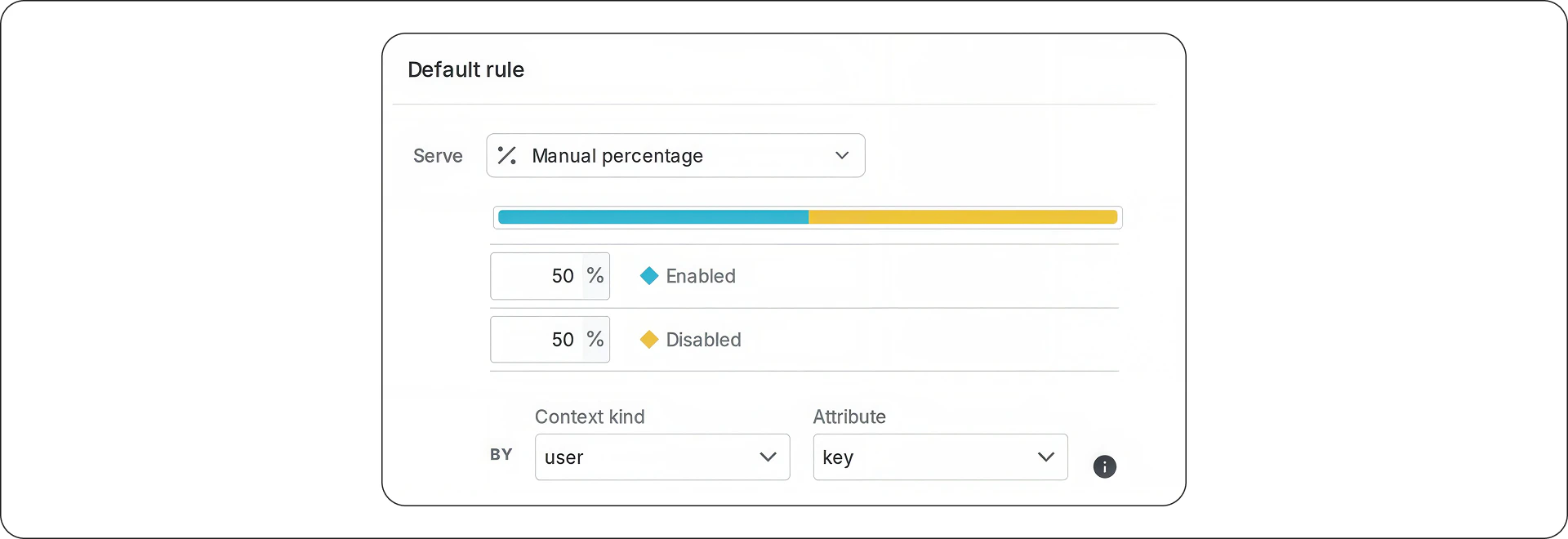
A percentage rollout can split traffic between flag variations, allowing teams to expand exposure gradually as production metrics remain stable.
Rollback is especially important for ML systems because a model can fail even when the service itself is healthy. The API may still return successful responses, while the predictions become less accurate, biased, stale, or misaligned with business goals. Runtime rollback gives teams a faster mitigation path than rebuilding and redeploying the application.
Targeting and kill switches
Feature flags can also target specific users, environments, or segments. Teams can expose a new model only to internal users, beta customers, low-risk traffic, or a specific region before broader release. This makes production validation more controlled and helps teams compare model behavior across defined groups.
For example, a team can require a prerequisite flag to be enabled, then expose the new model only to a beta tester segment before broader rollout.

LaunchDarkly targeting rules can expose a model behavior only when prerequisite flags and user-segment rules are satisfied.
For high-risk use cases, a kill switch is an option that provides a fast way to disable a problematic model or route traffic to a fallback model. This is useful for systems such as fraud detection, financial decisioning, healthcare workflows, or any application where incorrect predictions can create serious user or business impact.
Used this way, LaunchDarkly does not replace a model registry, serving platform, monitoring stack, or CI/CD pipeline. It provides the runtime control layer that helps teams manage model exposure after deployment.
Monitoring and logging
Monitoring remains essential after a model is deployed. A production ML service can appear healthy at the infrastructure level while the model itself produces degraded, biased, stale, or incorrect predictions. This is often called a silent failure: The API still returns successful responses, but the prediction quality has changed.
Effective monitoring should cover both system behavior and model behavior. System metrics show whether the service is operating reliably; model metrics show whether the predictions remain useful and safe.
Key areas to monitor include:
- Latency and throughput: Track response times, request volume, and requests per second to make sure the model service meets production requirements.
- Error rates: Log API errors, failed inference requests, timeouts, and exceptions.
- Prediction quality: Compare predictions against ground truth (where available), sampled human review, delayed labels, or business outcome metrics.
- Data drift: Track changes in input feature distributions compared with the training or validation data.
- Prediction drift: Monitor whether output distributions change unexpectedly, such as a fraud model suddenly flagging far more transactions than usual.
- Business impact: Connect model behavior to business metrics such as conversion rate, approval rate, false-positive rate, user engagement, or operational cost.
Monitoring is also important during the gradual rollout. When a new model version is released to a small traffic segment, teams should compare its metrics against the current baseline before increasing exposure. If the new version shows higher latency, worse prediction quality, or negative business impact, the rollout should stop.
When feature flags are used for model release control, monitoring data should be tagged by model version or flag variation. This allows teams to compare old and new model behavior separately instead of mixing all traffic into one aggregate view.
For example, if model_v2 is served to 10% of users through a feature flag, dashboards should show latency, error rate, traffic volume, sample size, prediction distribution, and business metrics for both model_v1 and model_v2. This prevents teams from over-interpreting results from a rollout population that is too small to support a reliable comparison.
Logging supports the same workflow. Logs should capture request IDs, model version, feature schema version, prediction result, error details, and relevant rollout context. These records help teams investigate incidents, audit model behavior, and understand whether a problem came from the model, the data, the application, or the release configuration.
Monitoring and logging do not prevent every model failure, but they make failures visible early enough for teams to respond. Combined with runtime release control, they help teams detect abnormal behavior, limit blast radius, and roll back before a poor model affects all users.
Model retraining and updates
Models often degrade after deployment because production data changes over time. User behavior may shift, seasonal patterns may appear, market conditions may change, or the input data distribution may drift away from the training dataset. A model that performed well at launch may become less accurate or less useful months later.
Retraining should be treated as a production update, not just a data science task. A retrained model should go through the same deployment controls as any other model release: validation, packaging, versioning, staging, gradual rollout, monitoring, and rollback planning.
Common retraining strategies include:
- Scheduled retraining: Retraining the model on a fixed schedule, such as weekly, monthly, or quarterly, using newer data.
- Performance-triggered retraining: Retraining only when accuracy, drift, false-positive rate, latency, or another monitored metric crosses a defined threshold.
- Shadow deployment or A/B testing: Run a retrained model alongside the current model to compare behavior before broader release. In an A/B test, the same ml-model-version flag can be used as the treatment in a LaunchDarkly experiment, so teams can compare model_v1 and model_v2 with per-variation metrics and proper sample-size handling instead of relying only on hand-built dashboards.
For example, a team may deploy a retrained model to production infrastructure but expose it to only 10% of users through a feature flag. During that rollout, the team compares latency, error rate, prediction distribution, and business metrics against the current model. If the rollout is structured as a LaunchDarkly experiment, the ml-model-version flag can also help measure model_v1 against model_v2 by flag variation. If the new version performs well, traffic can gradually increase. If it performs poorly, the team can stop the rollout and route traffic back to the previous model.
Scaling and performance optimization
Production ML systems often need to handle uneven traffic while keeping inference latency and infrastructure cost under control. Scaling is especially important for real-time model APIs because slow predictions can directly affect user experience, transaction approval, recommendations, or downstream application behavior.
Common scaling and optimization strategies include:
- Horizontal scaling: Running multiple replicas of the model service and distributing requests across them.
- Vertical scaling: Increasing CPU, GPU, memory, or accelerator resources for a single model-serving instance.
- Request batching: Grouping multiple inference requests together to improve hardware utilization and reduce per-request overhead.
- Caching: Reusing predictions or feature lookups when inputs are repeated or change slowly.
- Model optimization: Using techniques such as quantization, pruning, or distillation, and considering inference runtimes such as TensorRT or ONNX Runtime when hardware-specific acceleration or lower latency is required.
- Fallback models: Routing traffic to a simpler or lighter model when the primary model is unavailable, overloaded, or too slow.
Scaling decisions should be tied to production metrics. Teams should monitor p95 or p99 latency, throughput, CPU/GPU utilization, memory usage, queue depth, timeout rate, and cost per inference. These metrics help determine whether the system needs more replicas, larger instances, request batching, model optimization, or architecture changes.
Feature flags can support performance management when teams need runtime control over traffic behavior. For example, teams can route a small percentage of users to a new optimized model, shift low-risk traffic to a lighter fallback model during peak demand, or test whether a compressed model improves latency without hurting prediction quality.
Performance optimization should not ignore reliability or governance. If a model is replicated across regions or scaled across many instances, teams still need consistent access control, logging, data handling, and audit logging and traceability across all serving environments.
Security and compliance
(Below is general technical guidance and not legal or compliance advice)
Security and compliance become especially important when deployed ML systems process sensitive or regulated data, such as personal information, financial transactions, healthcare records, or behavioral data. A production model API should be protected like any other production service, with additional attention to model artifacts, feature data, prediction logs, and rollout configuration.
Key considerations include the following:
- Authentication and authorization: Model APIs should validate caller identity using OAuth, API keys, service accounts, or token-based authentication. Role-based access control should restrict access to model endpoints, logs, artifacts, and deployment configuration.
- Encryption in transit and at rest: Inference requests should use HTTPS/TLS. Model artifacts, feature data, persisted predictions, and logs should be encrypted at rest according to the organization's security standards.
- Data minimization: Inference services should receive only the features needed to make predictions. Reducing unnecessary input data limits exposure if logs, requests, or downstream systems are compromised.
- Auditability and logging: Teams should record model changes, configuration updates, rollout adjustments, access events, and rollback decisions. Audit trails help with incident investigation, compliance review, and operational accountability.
- Regulatory alignment: Teams working in regulated environments may need to align deployment practices with requirements such as GDPR, HIPAA, SOC 2, PCI-DSS, or internal governance policies. The exact requirements depend on the data, region, industry, and use case.
Security should be part of the deployment design, not an afterthought. Without access control, encryption, audit logging, and clear ownership of model changes, even a technically accurate model can create unacceptable business or regulatory risk.
Conclusion
Successful machine learning model deployment requires more than strong training accuracy. A production-ready model needs reproducible environments, reliable packaging, clear versioning, automated validation, monitoring, scalable infrastructure, and security controls.
The most important operational principle is separating deployment from release. Deploying a model makes it available in the production environment; releasing a model exposes it to users or production requests. Treating these as separate steps helps teams validate new model versions, control rollout risk, and roll back quickly when production metrics degrade. This matters most in real-time ML systems, where a poor model update can immediately affect users, transactions, recommendations, or business outcomes. Runtime controls such as feature flags, gradual rollouts, targeting rules, and kill switches make model updates more controlled and reversible.
When deployment automation, monitoring, governance, and runtime release control work together, machine learning systems can move from experimental prototypes to reliable production services.