
Key Takeaways
- Reproducible runs need parameters and configs, metrics, artifacts, code version (Git SHA), environment snapshot, data lineage, resource usage, and a model registry handoff.
- Seven anti-patterns break experiment tracking: local-only storage, missing data lineage, overwritten runs, manual run naming, logging only final metrics, no environment capture, and no link between a run and the deployed model version.
- The EU AI Act sets a minimum six-month retention period for automatically generated logs from high-risk AI systems under the provider's or deployer's control, unless another law specifies otherwise.
- Experiment tracking qualifies a candidate model, while runtime controls such as feature flags govern exposure through targeting rules, percentage rollouts, and instant rollback without redeploying.
Machine learning experimentation scales quickly. What begins as a handful of exploratory runs that vary hyperparameters, architectures, datasets, or feature engineering strategies can expand into dozens or hundreds of training jobs across notebooks, scripts, and CI pipelines. In LLM-based systems, the surface area grows further to include prompt templates, temperature settings, base model choices, hosted API settings, and fine-tuning configurations. Without structured experiment tracking, results become fragmented across local directories, object storage, and spreadsheets.
In production systems, this fragmentation is not sustainable; reproducibility becomes an operational requirement. When a deployed model underperforms, teams must determine which dataset snapshot, hyperparameters, code commit, and evaluation criteria produced it and how it differs from prior versions. Without reliable experiment records, root-cause analysis slows, rollbacks become risky, and regulatory obligations become difficult to satisfy.
In this article, “experiments” refer to offline training runs under controlled conditions. Experiment tracking records parameters, metrics, artifacts, environments, and lineage, linking training, registry, and deployment into a governed lifecycle.
Summary of key concepts in experiment tracking
Concept | Description |
|---|---|
Core components of experiment tracking | Core components include experiment metadata, artifacts, metrics, and lineage. |
Tracking system architecture | Defines how tracking integrates with training pipelines, storage systems, and experiment metadata services. |
Capability requirements for tracking systems | Outlines the features needed for scalable, production-ready tracking, including lineage, governance, and collaboration. |
CI/CD and model lifecycle integration | Connects experiment results to model promotion, deployment decisions, and runtime controls in production. |
Feature flags and gradual rollouts | Connects qualified experiment candidates to controlled production exposure, allowing teams to target specific cohorts, use percentage rollouts, monitor real-world behavior, and roll back without redeploying. |
Governance, compliance, and auditability | Ensures that experiment history, model decisions, and data lineage are traceable for regulatory, auditing, and team accountability needs. |
Common anti-patterns in experiment tracking | Common anti-patterns include loss of data lineage, poor storage and logging practices, overwritten experiment history, and weak linkage between experiments and deployed models. |
When experiment tracking is not required | Scenarios include simple models, one-off experiments, and stable workflows where iteration and comparison are minimal. |
Advanced and large-scale use cases | Explains how tracking evolves for distributed training, LLM workflows, and complex production environments |
What are the core components of an experiment tracking system?
The primary components of an experiment tracking system include experiment metadata, configuration details, execution context, metrics, artifacts, outputs, and links to downstream systems such as a model registry.

Parameters and configurations
Effective experiment tracking starts with meticulous configuration management, including model architecture, hyperparameters, and preprocessing. Mature systems use tools like Hydra or OmegaConf for versioned, explicit configuration, avoiding manual files and “hidden” defaults.
Tracking should also include a configuration difference (“diff”) relative to a baseline for clear hyperparameter exploration. For LLM systems, configuration must also include prompt templates, sampling settings such as temperature and top-k/top-p, base model ID, and fine-tuning settings. For fine-tuning or open-weight workflows, tokenizer versions should also be tracked because tokenizer mismatches between training and serving can create train/serve skew. LaunchDarkly AgentControl configs extend this pattern at runtime by managing model configuration, prompts, and messages as versioned variations outside application code.
Metrics
Experiment tracking must capture metrics — raw signals like batch loss, plus aggregated summaries appropriate to the task: accuracy and F1 for classification, latency and cost for serving, and quality scores for generation. For LLM output, n-gram overlap metrics like BLEU correlate poorly with quality; modern evaluation scores generations with an LLM-as-judge against a rubric, run offline before promotion and continuously in production through online evaluations. Capture training events too (early stopping, anomalies, gradient issues) for diagnosis. Crucially, it requires visualization and comparison across runs to enable structured evaluation, not just storage.
Artifacts
Artifacts, including model checkpoints and evaluation reports, preserve outputs and are essential for model reuse, rollback, and fine-tuning. Tracking systems must also record dataset references for context and reproducibility.
LLM workflows complicate artifact management due to their numerous large files, like fine-tuning checkpoints (saved model states during training), LoRA adapters, and RLHF reward models. Storage must reliably handle multi-gigabyte artifacts. Critical artifact versioning involves retaining “best” and “last” checkpoints, linking evaluation reports to runs, and supporting rollback.
Code versioning
Model artifacts are meaningless without code context. Every experiment run must be bound to a specific code state, typically through a Git SHA, branch name, and (optionally) a diff. This prevents a common failure mode where a model artifact cannot be reproduced because the underlying code has changed.
When debugging a production issue, teams often discover that code has evolved since the model was trained. Logging the exact commit hash eliminates ambiguity. If necessary, the exact code state can be restored and re-executed. Experiment tracking systems should treat code state as a first-class component of the run record.
Environment tracking
Even with identical code and configuration, environment differences can cause nondeterministic behavior. For example, dependency versions, Python interpreter versions, CUDA drivers, GPU types, and container images can all influence results. For some workloads, especially those relying on GPU kernels or distributed training frameworks, even minor differences in library versions can produce divergent behavior.
A robust tracking system records dependency snapshots such as pip freeze outputs or Conda environment files. It also logs hardware characteristics and Docker image digests. This allows teams to reconstruct the exact training environment when necessary. Reproducibility is not complete unless the execution environment can be reconstructed.
Data lineage
Data is often the least controlled dimension of experimentation, yet it directly determines model behavior. Each run must reference a specific dataset snapshot, schema version, feature store version, and preprocessing pipeline. If transformations change without being recorded, comparisons become invalid.
Lineage metadata should clearly show how training inputs differ between runs. In LLM systems, this includes dataset filtering logic, prompt formatting rules, curated instruction sets, and, for fine-tuning or open-weight workflows, tokenizer versions. Even minor shifts can materially affect outcomes and must be logged explicitly.
Resource usage
As workloads scale, resource tracking becomes operationally significant. GPU utilization, CPU and memory usage, training duration, and distributed job statistics reveal bottlenecks and cost drivers. In large-scale training or LLM fine-tuning, compute is often the primary constraint.
Logging this data enables infrastructure optimization and per-run cost estimation, especially as experimentation volume grows.
Model registry handoff
Experiment tracking identifies candidate models but does not govern deployment. Runs that meet defined evaluation criteria should link directly to a model registry entry, creating a traceable relationship between training execution and versioned artifact.
The tracking system should record the criteria used to justify candidacy, such as accuracy thresholds, fairness checks, latency constraints, or domain KPIs. The model registry then manages lifecycle stages, including staging, shadow evaluation, and production. Runtime configuration systems — LaunchDarkly AgentControl — control user exposure: once a candidate is registered, targeting rules and percentage rollouts decide which users receive it, without redeploying. Experiment tracking determines eligibility; LaunchDarkly governs exposure.
Experiment tracking architecture
Experiment tracking connects the ML lifecycle stages by maintaining a shared record of experiments across training, evaluation, deployment, and monitoring. A well-designed tracking pipeline must support distributed training, multi-team collaboration, CI automation, and production feedback loops without becoming a bottleneck.

Tracking server
At the core of the system is a tracking server that acts as a central metadata collector. All experiment runs, whether launched locally or through CI pipelines, report their parameters, metrics, artifacts, and lineage to this server. In distributed training scenarios, multiple workers may log concurrently, so the tracking service must handle parallel writes, partial updates, and long-running sessions without data corruption. It should also be resilient to network interruptions, ensuring that experiment data can be buffered, retried, or safely resumed if connectivity is temporarily lost.
In multi-team environments, access control is critical. Role-based access control and organization-level scoping prevent accidental modification or deletion of experiments. Research teams, platform engineers, and production operators may require different permissions. Without proper isolation, the tracking system itself becomes a governance risk. The tracking server should be treated as infrastructure, not as a developer convenience tool.
Storage backends
Behind the tracking server, storage is typically separated by data type. Metrics are often stored in relational databases that support structured queries and filtering across runs. Artifacts such as model checkpoints, evaluation reports, and plots are usually stored in object storage systems such as S3, GCS, or MinIO. Metadata may reside in either relational or NoSQL systems, depending on query complexity and scale requirements.
Code integration is handled through version control systems and container registries. Git commit identifiers and Docker image digests are not stored as raw code but as references that bind the run to an immutable state. This separation ensures scalability. Metrics remain queryable, artifacts remain durable, and metadata remains searchable.
Local vs. remote workflows
Not all experimentation begins in a shared environment. During early prototyping, developers often log runs locally, which is acceptable as long as promising runs can be promoted to a centralized tracking server. Mature systems support importing local runs into the shared registry to avoid fragmentation.
The key principle is that local tracking is for iteration speed and remote tracking is for reproducibility and collaboration. Once experimentation influences model selection or deployment decisions, it must be recorded centrally. Otherwise, production decisions become detached from traceable history.
CI/CD integration
Automated logging of configurations, metrics, artifacts, and lineage is essential for scalable training pipelines in CI environments. Manual logging is insufficient: The system must record details for all runs, including stack traces and partial data for failures, as failed runs are vital for debugging and auditing.
CI dashboards should display experiment metadata in real time for quick evaluation. After offline experiment tracking identifies a candidate model, LaunchDarkly acts as the control plane for production exposure — targeting specific cohorts, running percentage rollouts, and reverting instantly, all without redeployment. Experiment tracking determines eligibility; LaunchDarkly governs controlled exposure.
Feature store integration
Feature consistency is a common failure point in production ML systems. An experiment tracking architecture should integrate with the feature store so that the exact feature version used during training is recorded. If schema changes or transformation logic diverge across environments, the system should surface this discrepancy early. Feature lineage must be part of the experiment record, not an afterthought.
Monitoring and retraining the feedback loop
A complete ML architecture links offline experimentation to production signals. Production monitoring detects drift, anomalies, and SLO violations, feeding back into the experimentation layer. Advanced systems can automatically trigger new, logged retraining runs based on these signals, creating a closed loop: Monitor, retrain, evaluate, and promote. Real-time quality signals also inform rollbacks: if a deployed model degrades, traffic reverts to a stable version while new experiments run offline. With LaunchDarkly AgentControl, these signals come from the runtime itself — the AI SDK records token usage, latency, cost, and success or error per variation, alongside any online-evaluation judge scores. Those per-variation metrics are what a guarded rollout watches to pause or revert automatically, and what triggers a new logged retraining run.
Capability requirements for tracking systems
Not all experiment tracking systems are equal. Some function as lightweight metric loggers; others operate as central coordination layers across the entire ML lifecycle. When evaluating a system, teams should look beyond surface features and assess whether it can support reproducibility, governance, scale, and operational integration. The following capabilities distinguish mature platforms from basic tooling.
Core functionality
A minimum MLOps experiment tracking system must reliably capture all configuration parameters (hyperparameters, augmentation, architecture, preprocessing, and seeds) automatically. Manual logging risks drift. Metric tracking needs both step-level (e.g., batch loss) and aggregated views, ensuring continuity for long jobs and supporting custom KPIs.
Artifact storage must scale for multi-gigabyte checkpoints, reports, and plots. It requires integration with object storage (S3, GCS, MinIO) for efficient handling of large uploads. Environment capture is essential for reproducibility, logging dependency, Python/CUDA, hardware, and container details. Code version binding is mandatory. Each run must link to the exact commit SHA and repository state for debugging and auditability.
Data and lineage features
A mature system must support dataset version tracking. Every run should be linked to a dataset snapshot or hash to ensure deterministic inputs. If data changes silently between runs, model comparisons become unreliable.
Feature store integration is critical for teams operating at scale. The system should record the exact feature set version used during training and help detect inconsistencies between training-time and inference-time features.
Beyond isolated records, the platform should enable a complete lineage graph that connects data to features, features to experiments, experiments to model artifacts, and model artifacts to deployment stages. Such a lineage is essential for debugging, audit workflows, and regulatory compliance.
Schema or version diffing adds another layer of protection. If a dataset schema changes or a feature definition is modified, the system should surface those differences explicitly rather than allowing silent degradation of model quality.
Performance and scalability
As experimentation volume grows, the system must handle multi-hour or multi-day training jobs without losing logs or corrupting sessions. It must also aggregate metrics from distributed training across multiple nodes or GPUs in a coherent manner.
Search and filtering should remain fast even when thousands of runs are stored. Teams should not experience degraded performance as experiment history grows. Support for large artifacts is especially important for LLM workflows. Multi-gigabyte checkpoints should not cause UI crashes or upload timeouts. Storage and retrieval must remain stable under heavy load.
Cost and resource telemetry
Compute cost is a material constraint in modern ML systems. The tracking platform should log GPU, CPU, and memory utilization across the duration of each run. This helps diagnose bottlenecks and optimize infrastructure efficiency. Per-run cost estimation is increasingly valuable for cloud GPU workloads, where experimentation directly impacts the budget.
For LLM fine-tuning and other high-cost workflows, logging compute footprint and checkpoint characteristics is not optional. It becomes part of operational planning and financial governance.
Security and governance
As models move toward production, governance requirements increase. Role-based access control should restrict who can view, modify, promote, or delete experiment records. This protects production-bound artifacts from accidental or unauthorized changes.
Audit logging should be tamper-resistant and comprehensive. Every promotion, deletion, or configuration change should leave a traceable record. In regulated industries, this is often a compliance requirement.
Workspace separation further strengthens governance. Research, staging, and production experiments should be logically separated to prevent cross-contamination and reduce risk.
Integration capabilities
Experiment tracking does not exist in isolation. The system should support model registry handoff so that qualified runs can be promoted into versioned model entries with defined deployment stages. Once a run reaches a deployment stage, the registry records that lifecycle state, while LaunchDarkly governs which users receive the candidate through targeting rules and percentage rollouts. This linkage must be reproducible and traceable.
CI/CD hooks are essential. Training runs executed within CI pipelines should automatically log parameters, metrics, and artifacts. The system should also support deployment gates that block promotion if regressions are detected. CI gates catch regressions before promotion; LaunchDarkly guarded rollouts are the runtime counterpart, catching regressions that only appear under live traffic and reverting automatically without redeploying.
Integration with monitoring platforms such as Prometheus or Grafana strengthens the feedback loop between training and production. For LLM and AI systems, LaunchDarkly AgentControl supplies the runtime metrics directly — token usage, latency, cost, and online-evaluation judge scores per variation — tied to the config and variation that produced them. Experiment metadata combined with these runtime metrics enables drift detection and faster diagnosis of performance issues.
User experience
Finally, usability determines adoption. Dashboards should allow fast filtering by tags, parameters, dataset versions, and metrics. Engineers must be able to locate relevant runs quickly.
Run comparison views should support side-by-side analysis across experiments, highlighting metric differences and configuration changes.
Tagging, grouping, and experiment templates help teams enforce metadata standards and maintain consistency across projects. Without these organizational tools, experiment history becomes difficult to navigate as the scale increases.
When evaluating an experiment tracking system, teams should treat these capabilities not as optional enhancements but as structural requirements. The goal is not simply to record experiments. The goal is to support reproducible engineering, safe model promotion, and scalable governance across the full ML lifecycle.
CI/CD and model lifecycle integration
Experiment tracking becomes significantly more powerful when it is integrated into CI/CD pipelines.
Automated logging
Every training job triggered through CI should log its full execution context automatically. When a pipeline runs, it should capture parameters, metrics, artifacts, environment details, and data references without requiring manual intervention. The run record should also include the Git commit SHA and the CI pipeline identifier. This linkage creates traceability between source code, pipeline execution, and resulting model artifacts.
If a regression is introduced in a specific commit, the corresponding experiment run can be identified immediately. Conversely, if a model candidate performs well, the exact code and pipeline context that produced it are known. This level of traceability is essential for auditability and debugging.
Automation also ensures that no runs are “forgotten.” Every CI-triggered training event becomes part of the historical record.
Deployment gates
Model promotion should not be manual or subjective. Before a model is registered or moved to a higher lifecycle stage, automated quality gates should evaluate its performance. These gates can enforce minimum thresholds for metrics such as accuracy, latency, fairness constraints, or domain-specific KPIs.
If the model fails to meet the defined criteria, promotion is blocked. This prevents accidental deployment of degraded candidates and reduces operational risk. Quality gates themselves should be versioned and reproducible. If thresholds change, that change must be traceable just like any other configuration.
Automated rollback
Automation should extend beyond promotion to protection. If a newly deployed model underperforms in production according to predefined monitoring signals (e.g., accuracy degradation, increased prediction latency, or rising error rates), rollback mechanisms should be available. A LaunchDarkly guarded rollout can revert traffic to the previous stable model automatically when a monitored metric regresses, without redeploying the service.
While experiment tracking governs which model qualifies as a candidate, runtime controls manage exposure in real time. Automated rollback policies close the loop between evaluation and production safety.
Automated comparison
An effective CI/CD workflow includes a structured comparison step. At the end of the pipeline, the newly trained model should be evaluated against a defined baseline. The baseline is typically a previously deployed production model, a validated reference model, or a fixed benchmark dataset used for regression testing. This comparison should consider multiple metrics rather than a single performance value. The system can then automatically label the candidate as improved, equivalent, or regressed.
This explicit comparison step reduces ambiguity in model selection. It also provides a clear audit trail showing why a model was or was not promoted. Over time, this approach builds a history of objective decisions rather than subjective judgments. Offline comparison qualifies a candidate; a LaunchDarkly experiment then measures its real-world impact per variation on live traffic, so promotion to 100% is a data-backed decision rather than an offline score alone.
Full ML lifecycle visibility
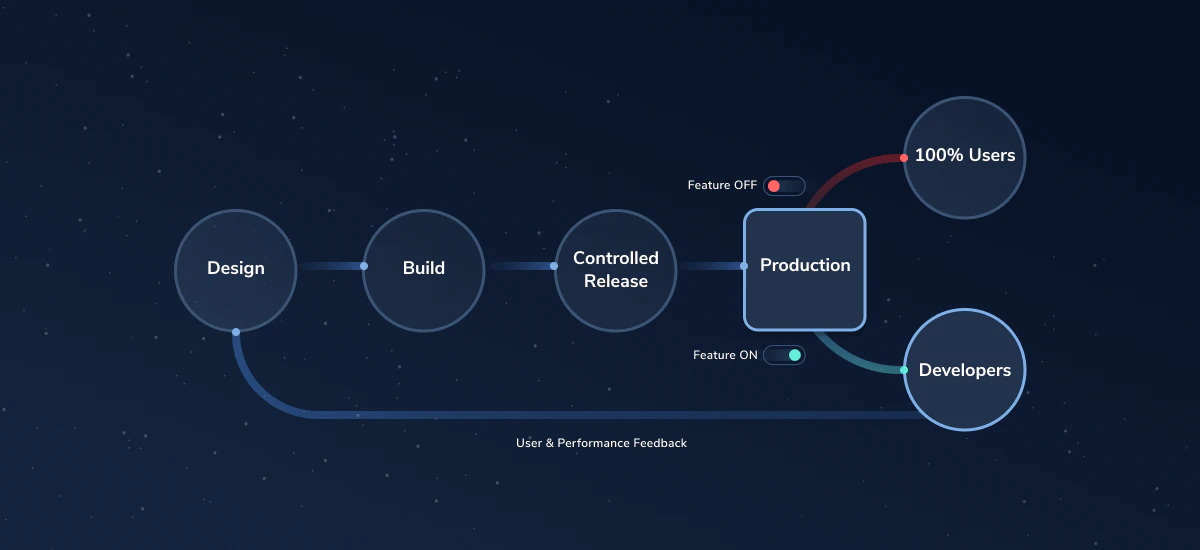
When experiment tracking and CI/CD automation are integrated, the ML lifecycle forms a continuous loop: track, evaluate, register, deploy, monitor, detect drift, and retrain. Each stage feeds the next while preserving lineage across runs and model versions. The diagram below illustrates this feedback cycle.

LaunchDarkly’s feature flag lifecycle reinforces this loop by enabling safe rollout, monitoring-driven rollback, and rapid iteration without redeployment.
Governance, compliance, and auditability
As machine learning systems move into regulated environments, experiment tracking becomes part of the compliance framework.
Regulatory requirements
Specific requirements vary by jurisdiction, industry, and model use case. For high-risk AI systems, the EU AI Act establishes technical logging and record-retention requirements, including a minimum six-month retention period for automatically generated logs under the provider’s or deployer’s control, unless another applicable law specifies otherwise. It also establishes requirements for technical documentation and documented quality-management processes. In personal-data contexts, GDPR Article 22 restricts certain decisions based solely on automated processing that produce legal or similarly significant effects and requires safeguards such as human intervention. In U.S. banking, the Federal Reserve, FDIC, and OCC’s April 2026 Revised Guidance on Model Risk Management calls for risk-based model governance, model inventories, validation, and adequate documentation for traditional statistical, quantitative, and non-generative, non-agentic AI models. In FDA-regulated environments, 21 CFR Part 11 establishes controls for trustworthy electronic records and signatures when the underlying records are subject to FDA requirements. Experiment tracking can provide evidence supporting these obligations, but it does not by itself establish regulatory compliance.
Audit workflows
Auditability requires the ability to reproduce a model months or years after deployment. Teams must be able to retrieve the exact experiment run that produced an artifact, including configuration, code commit, environment snapshot, dataset hash, and evaluation metrics.
In regulated environments, reviewers may request documentation of the dataset version used for training, the preprocessing logic applied, the validation metrics that justified approval, and the individual or system that authorized promotion. A mature tracking system should surface this information directly from recorded metadata rather than relying on manual reconstruction.
Cross-project governance
For scaling organizations, governance must extend beyond teams. Organization-wide naming conventions and metadata standards ensure consistent experiment history, making model comparison across business units reliable.
Access control must define who can create, modify, promote, or delete experiment records and model versions, protecting production artifacts and minimizing risk. Explicit promotion/demotion policies must define the authority to move models into production, revert, or retire them, recording these decisions in the history.
Common anti-patterns in experiment tracking
Adopting an experiment tracking tool does not automatically produce disciplined practice. Many failures in ML systems can be traced back to recurring anti-patterns that undermine reproducibility, comparability, and governance. Recognizing these patterns early helps teams avoid costly rework later.
Storing results only locally
One of the most common mistakes is keeping results on local machines or ephemeral storage. For example, checkpoints saved to a laptop, metrics recorded in notebooks, or artifacts stored in temporary cloud buckets quickly become inaccessible. When the original author leaves the team or the environment changes, those runs are effectively lost. Reproducibility becomes impossible because the execution context cannot be reconstructed. Centralized tracking is not optional for production-bound systems. If results are not durably recorded in a shared system, they should not influence deployment decisions.
Missing data lineage
Data lineage failures are a primary cause of silent model drift. If dataset versions, feature transformations, or preprocessing logic are not logged explicitly, teams cannot determine how training inputs differed between runs. A small change in filtering logic or feature engineering can materially affect model behavior, yet remain invisible without lineage tracking.
When drift appears in production, lack of data traceability often prevents clear root-cause analysis. Proper lineage logging should be treated as a core requirement, not as a secondary feature.
Overwriting previous runs
Overwriting experiment outputs destroys history. For example, replacing a checkpoint file or reusing a run identifier eliminates the ability to compare historical results. Even if the new model performs better, the absence of the prior record prevents structured comparison and auditability.
Every experiment run should be immutable once recorded. Historical context is part of the system’s integrity.
Manually naming experiments
Ad hoc naming conventions introduce ambiguity, and manually assigned run names often lack structure and consistency. As the number of experiments grows, searching and filtering become difficult as important metadata becomes buried in free-text labels.
Systematic naming templates and structured tagging prevent this entropy. Naming discipline is foundational for scalable experimentation.
Logging only the final metrics
Recording only the final evaluation metric hides important dynamics. Training instability, divergence events, or plateau behavior are often visible in step-level metrics long before the final result is computed. Without logging intermediate signals, teams lose visibility into training dynamics and cannot diagnose instability effectively. Comprehensive metric logging should capture both granular and aggregated signals.
No environment logging
Even when code and parameters are tracked, missing environment information can break reproducibility. Differences in library versions, CUDA drivers, hardware configurations, or container images may alter model behavior. Without environment snapshots, two runs that appear identical on paper may produce different results.
Environment logging must include dependency versions, hardware context, and container identifiers. Reproducibility is incomplete without it.
No link between experiment and model registry
Separating experiment tracking from model registry management creates governance gaps. If a deployed model cannot be traced back to a specific experiment run, audit workflows break down. There must be an explicit, reproducible relationship between a candidate experiment and the model version promoted to deployment.
Experiment tracking determines how a model was trained; the model registry determines its lifecycle stage. When these systems are not integrated, deployment decisions lose traceability.
These anti-patterns share a common theme: loss of lineage. Whether through missing data references, overwritten runs, incomplete logging, or broken registry linkage, the result is the same: The system becomes difficult to reproduce, compare, and govern.
Avoiding these patterns is less about tooling and more about enforcing discipline. Experiment tracking only fulfills its purpose when it is treated as infrastructure rather than as a convenience.
When experiment tracking is not needed
Experiment tracking is fundamental for production-grade ML systems, but it is not mandatory in every context. There are scenarios where the overhead of a full tracking pipeline may not be justified. The key is to distinguish between temporary exploration and work that could influence long-term decisions.
Early exploratory research
In very early-stage research, teams may be testing feasibility rather than optimizing for deployment. A small number of quick experiments run interactively to validate a hypothesis may not require a fully integrated tracking server.
However, even in exploratory phases, it is still advisable to record configurations and core metrics in some structured form. Many production systems begin as exploratory prototypes. What starts as “just a quick test” often evolves into a baseline, and if no record exists, reproducibility is lost before the project matures.
The cost of lightweight logging is small compared to the cost of recreating lost context later.
Visual prototyping and isolated notebooks
Notebook-driven exploration focused on visualization, data inspection, or UI prototyping may not warrant full experiment lineage tracking. If the goal is to explore data distributions, validate assumptions, or demonstrate an idea internally, a simplified logging approach may be sufficient. In these cases, teams typically log only essential metadata such as dataset version, key model parameters, and a small set of evaluation metrics to preserve basic reproducibility without introducing full experiment management overhead.
The critical question is whether the outputs of the notebook will influence model selection, evaluation, or deployment decisions. If they will, then structured tracking becomes necessary. If they are purely exploratory and disposable, lighter-weight practices may be acceptable.
Small academic or educational exercises
In limited academic assignments or small-scale educational projects, full experiment governance is often unnecessary. If the dataset is static, the environment is controlled, and the project scope is short-lived, the complexity of a full tracking architecture may exceed its benefit.
That said, learning to use structured experiment tracking in academic settings can build good habits early on. The absence of strict requirements does not eliminate the value of disciplined practice.
Experiment tracking becomes essential once experimentation affects shared systems, production decisions, regulatory requirements, or long-term maintainability. If a model might influence users, revenue, safety, or compliance, structured tracking is no longer optional. The transition point is not defined by project size but by operational impact.
Advanced use cases: LLMs and distributed training
As ML systems evolve, experiment tracking requirements become more demanding. Large language models and distributed training introduce scale, cost, and architectural complexity that basic tracking setups often cannot handle. These environments expose weaknesses in incomplete tracking practices very quickly.
LLM fine-tuning
LLM workflows extend beyond traditional hyperparameter tuning. In addition to learning rate and batch size, teams must log prompt templates, system instructions, temperature schedules, top-k and top-p sampling settings, tokenizer versions, and base model identifiers. Even small changes to prompt structure or tokenization logic can materially alter behavior. If these elements are not versioned and recorded, model comparisons lose validity.
Fine-tuning introduces further complexity. Adapter weights such as LoRA layers, reward models for RLHF, and intermediate checkpoints can be large and numerous. Multi-gigabyte artifacts are common. Storing these reliably requires a dedicated artifact strategy, typically backed by scalable object storage and explicit retention policies.
Cost awareness is essential in LLM systems. Fine-tuning runs can consume significant GPU hours and generate substantial cloud expenses. Logging resource usage and estimating per-run cost are no longer optional optimizations, now part of responsible experimentation. Teams must understand not only which configuration performs best, but which configuration delivers acceptable performance at sustainable cost. In LLM environments, experiment tracking must capture behavioral configuration, infrastructure footprint, and artifact scale with equal rigor.
Distributed training
Distributed training introduces coordination challenges that do not exist in single-node experiments.
Metrics must be aggregated across nodes. For example, loss values or accuracy scores may need to be synchronized and averaged across multiple GPUs or machines. The tracking system must ensure that logged metrics represent the true global state of the run rather than partial local observations.
Logging should also account for partial failures. In multi-node training, one worker may fail while others continue temporarily. The tracking system must record these failure events clearly. Otherwise, diagnosing instability becomes difficult.
Concurrency control is critical. Multiple processes may attempt to write logs simultaneously. The tracking infrastructure must handle concurrent updates without corrupting records or losing data.
Distributed workloads also amplify the importance of resource telemetry. GPU utilization imbalance, communication bottlenecks, or memory constraints can dramatically affect performance. Logging these signals alongside training metrics allows teams to diagnose inefficiencies that would otherwise remain hidden.
Advanced use cases expose the limits of lightweight tracking approaches. In LLM fine-tuning and distributed training, experiment tracking must scale in storage, concurrency, cost awareness, and behavioral configuration management. Without these capabilities, experimentation becomes expensive, opaque, and operationally risky.
Practical examples
The principles described above become clearer when applied to real workflows. The following examples illustrate how experiment tracking fits into both a classical ML pipeline and an LLM-based system.
Example 1: A classical ML pipeline
Consider a supervised learning system used for fraud detection:
- Version the data and preprocessing inputs. Record the dataset snapshot identifier, schema version, feature definitions, and preprocessing logic used for the run.
- Log the training configuration and execution context. Capture the model architecture, optimizer configuration, learning rate schedule, batch size, random seeds, code commit, dependency versions, container image, and hardware environment.
- Capture metrics, resource usage, and artifacts. Log step-level training signals and aggregated evaluation metrics such as precision, recall, and AUC. Store checkpoints, evaluation reports, plots, and resource telemetry against the same experiment record.
- Select and register a candidate. When a run satisfies the defined evaluation criteria, promote its model artifact to the model registry and preserve a direct link to the experiment that produced it.
- Expose the candidate gradually in production. Use LaunchDarkly feature flags to target a small cohort or use a percentage rollout while the existing model continues serving the remaining users.
- Monitor production behavior and roll back if necessary. Compare the candidate’s real-world quality, latency, error rate, and business metrics with the stable version. If performance regresses, return traffic to the stable model without redeploying the service.
In this workflow, experiment tracking governs qualification and lineage, while runtime controls manage production exposure risk.
Example 2: LLM experiment (prompt and model variation)
- Record the model and prompt configuration.
Log the base model identifier, prompt template, system instructions, sampling settings, and tokenizer version. - Log training and evaluation settings.
Capture fine-tuning parameters, evaluation rubrics, hallucination rates, toxicity scores, and domain-specific quality metrics. - Store artifacts and resource data.
Save LoRA weights, checkpoints, evaluation reports, GPU usage, training duration, and estimated cost. - Register the candidate variation.
Link the approved model or prompt variation to the experiment run and its evaluation results. - Configure controlled production exposure.
Use a LaunchDarkly feature flag or AgentControl config to decide which users receive the new model or prompt. - Evaluate the variation in application code.
Initialize the LaunchDarkly client, evaluate the flag for each user context, and close the client during shutdown.
- Monitor and roll back if needed.
Track quality, latency, token usage, cost, and errors, and revert the variation if performance degrades.
Conclusion
Experiment tracking marks the transition from informal experimentation to a disciplined engineering process. When every run is recorded with its configuration, metrics, artifacts, code state, environment, and data lineage, model development becomes reproducible rather than anecdotal. Decisions are based on traceable evidence instead of memory. Debugging becomes systematic instead of reactive.
Mature tracking systems do more than log metrics. They connect training-time experimentation with model registry workflows, CI/CD pipelines, runtime exposure controls such as LaunchDarkly feature flags and AgentControl for LLM workflows, and production monitoring. This integration enables governance, collaboration across teams, and automation throughout the lifecycle.
With the right architecture and disciplined practices in place, teams can iterate faster without sacrificing control. They can promote models with confidence, roll back safely when needed, and satisfy audit or regulatory requirements without reconstructing history from fragmented sources. Experiment tracking does not eliminate experimentation. It makes experimentation reliable, comparable, and operationally safe.
To see how LaunchDarkly supports runtime configuration and AI variation management, explore the AgentControl quickstart and the Python AI SDK documentation.