
Key Takeaways
- Standard CI/CD can break for AI in six ways: undetected model drift, prompt changes gated by release cycles, costly canaries, stale staging data, slow rollbacks, and cross-team deployment queues.
- A model registry records training-time metadata, not live performance, so accuracy can degrade on production traffic with no change to the model binary.
- Container-based rollback runs a build, push, and redeploy sequence that takes minutes rather than seconds, leaving degraded traffic in production throughout.
- Shadow deployment routes 5 to 10% of real production requests to a candidate model while suppressing its output from users.
Many AI deployment failures don't produce stack traces. A misbehaving model degrades gradually through drops in accuracy, shifts in output quality, or changes in user behavior. A misconfigured prompt causes regressions that only appear at scale. Neither failure triggers an infrastructure alert, and by the time the problem surfaces in dashboards or support tickets, the damage has already accumulated.
Standard CI/CD pipelines treat deployments as binary events: ship code, test it, release it. That model works for deterministic applications where the same input always produces the same output. AI systems don't work that way. A predictive model's behavior drifts as input distributions shift. An LLM's outputs change with prompt configuration, context length, and model version. Both can degrade between deployments, without a code change, without a pipeline run, and without anything that triggers standard infrastructure monitoring.
This article covers six areas where standard deployment patterns break down for AI workloads, along with the practices that address each gap. The failure modes apply across the spectrum: teams shipping predictive models, teams deploying LLM-based features, and teams managing both. They are common structural issues for many teams moving AI systems through a conventional CI/CD pipeline, regardless of the pipeline's maturity.
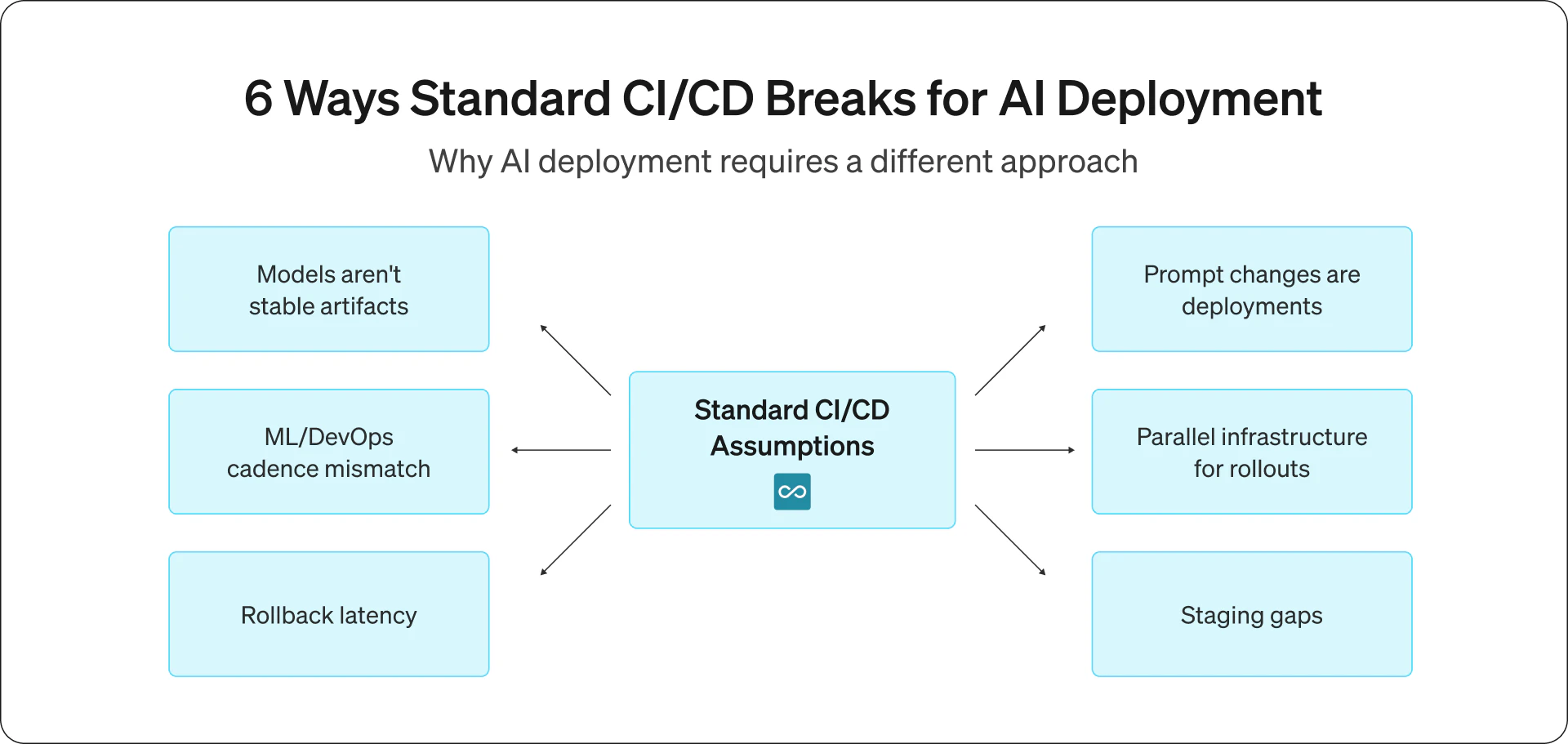
Summary of where standard CI/CD breaks for AI deployment
Failure point | Description |
|---|---|
AI models are not deterministic artifacts | A registry version records training-time data, not how the model performs on today's traffic. Input distributions shift continuously due to user behavior, upstream changes, and seasonal patterns. Behavior degrades without a deployment event, a code change, or anything that triggers a standard pipeline alert. |
Prompt changes are deployments in disguise | For prompt templates that live in application code, each change may require a full commit, review, staging, and production deployment cycle. Teams running many prompt experiments absorb heavy pipeline overhead and often skip validation steps that catch quality regressions. |
Gradual rollouts require parallel infrastructure | Canary deployments split traffic at the load balancer and assume both versions accept the same inputs. When two model versions have different feature schemas, each needs its own serving endpoint and feature store connection. Running a proper AI canary may potentially double the GPU infrastructure during the testing window. |
Staging environments don't reflect production for AI workloads | Staging datasets are snapshots of past traffic. Production traffic changes continuously through seasonal shifts, new user cohorts, and upstream pipeline changes. A model that passes every staging test can still fail on current live traffic because the distribution it was tested on is months out of date. |
Rollback latency can cause damage | Container-based rollback runs a build, push, and redeploy sequence that takes three to eight minutes. For a high-traffic inference endpoint, that window means tens of thousands of degraded interactions before the model is reverted. |
ML and DevOps teams operate on different cadences | Model training and application deployment run on separate schedules, each with its own toolchain. Manual handoffs between ML and DevOps teams add calendar time at deployment and slow incident response. |
The rest of the article explains these AI deployment failure points in detail.
1. Models are not deterministic artifacts
Most CI/CD pipelines were built around a single assumption: the deployable unit is a code artifact with a predictable build, test, and release cycle. The diagram below shows six ways AI deployment breaks that assumption.
Standard deployment pipelines treat versioned code as a stable unit. Deploy a container image tagged v2.1, and it behaves the same way tomorrow as it does today, unless you change it. AI models don't maintain that guarantee.
Artifact assumption | AI reality |
|---|---|
The same version leads to the same behavior | Same version, but behavior varies with input distribution |
Rollback restores the previous state | Rollback restores previous weights, not previous data patterns |
Test set accuracy predicts production accuracy | Test set accuracy reflects training-time distribution, not live traffic |
Deployment events trigger behavior change | Behavior changes continuously between deployments |
Role of model registry
A model registry version records the model artifact and its training-time metadata: the training dataset, the hyperparameters, and the code commit. It does not prove that the model still performs well on today's production traffic. It doesn't record how the model is currently performing on production traffic. Those are two different things, and the gap between them grows over time.
When the data flowing into inference changes, due to seasonal patterns, upstream schema changes, or shifts in user behavior, the model's outputs change too. This happens without a deployment event, a code change, or anything that would trigger a standard pipeline alert.
A model that achieved 94% accuracy on the validation set can drop to 76% on production traffic six weeks later, with no change to the binary and no entries in the deployment log to explain it.
Implications of rolling back a model to a previous version
Rolling back to a previous version to fix a degradation means deploying a model trained on even older data. If the incoming data distribution has shifted since that version was trained, the older version may not restore the behavior you're expecting. Unlike reverting a code change, there's no guarantee that the previous model version performs as it did when first deployed.
Close the gap with distribution monitoring
Model monitoring tools track input feature distributions, the statistical patterns in the values your model receives at inference time, over time, and alert when they diverge from training baselines.
2. Prompt changes are deployments in disguise
Prompt templates control how an LLM responds. Because they typically live in application code, changing a prompt requires the same pipeline as any other code change:
- Commit
- Pull request review
- Staging deployment
- QA validation
- Production deployment.
For teams iterating on many prompts at once, that overhead compounds quickly. Each experiment (adjusting tone, restructuring instructions, and adding a few-shot example) requires the full cycle. Depending on pipeline speed and review queue depth, that sequence takes hours per experiment. If you're running 10 prompt experiments per sprint, a meaningful portion of engineering capacity is devoted to deployment overhead for what are essentially configuration changes.
Teams respond by batching experiments and skipping validation steps. Instead of testing each prompt variant against a regression suite(a set of reference prompts and expected outputs used to catch quality regressions before promotion) before promotion, they bundle several changes into a single deployment and evaluate the results informally. Regressions that would have been caught by proper evaluation reach production, and when a quality drop appears, it's hard to isolate which change caused it.
Close the gap by separating prompt configurations from application code
The architectural fix is to move prompt configuration out of application code. With LaunchDarkly AgentControl, each prompt and model setup is a variation of a config that you edit in the UI and update at runtime; no commit, PR, or redeploy. That turns the homegrown loop this section describes into a built-in one:
- Iterate as variations. Adjusting tone, restructuring instructions, or adding a few-shot example creates a new variation, not a code change.
- Test before you ship. Use the playground to refine a variation interactively, then run offline evaluations against a dataset of reference inputs and expected outputs; the "regression suite" teams otherwise hand-roll and skip, now a repeatable workflow that is designed to help catch regressions before rollout.
- Score in production. Attach online evaluations (built-in LLM-as-judge scoring for accuracy, relevance, and toxicity, plus custom judges) so quality is measured on live traffic, not informally.
- Isolate regressions instantly. Every variation is versioned, so when a quality drop appears, you compare variation versions and read per-variation metrics on the Monitoring tab instead of bisecting a bundled deployment.
- Target and experiment. Serve variations to specific segments with targeting rules, and run experiments to measure impact on end-user behavior.
AgentControl configs work in two modes. Completion mode handles messages and roles for single-step LLM responses, such as chatbots, content generation, and classification tasks. Agent mode covers instructions for multi-step workflows, where coordination instructions and tool descriptions must also be updated at runtime without redeployment. Both modes decouple their respective configuration from the deployment pipeline.
3. Gradual rollouts require parallel infrastructure
Gradual rollouts are a standard risk-reduction technique in software deployment. But for AI systems, implementing them at the infrastructure level carries a significant cost penalty.
Blue-green deployments (where two production environments run side by side and traffic switches between them) and canary deployments (where a small percentage of traffic is routed to a new version before full release) work well for stateless services.
- Split traffic at the load balancer.
- Route a percentage to the new version
- Watch the metrics.
The assumption built into this model is that both versions accept the same inputs. However, this does not hold for AI
If v1 and v2 of a model were trained on different feature schemas, routing at the load balancer isn't sufficient. v2 needs its own connection to the feature store to fetch the new feature at inference time. It needs independence:
- Serving endpoints
- Resource allocation
- Separate metrics collection so v2's outputs don't contaminate v1's quality telemetry.
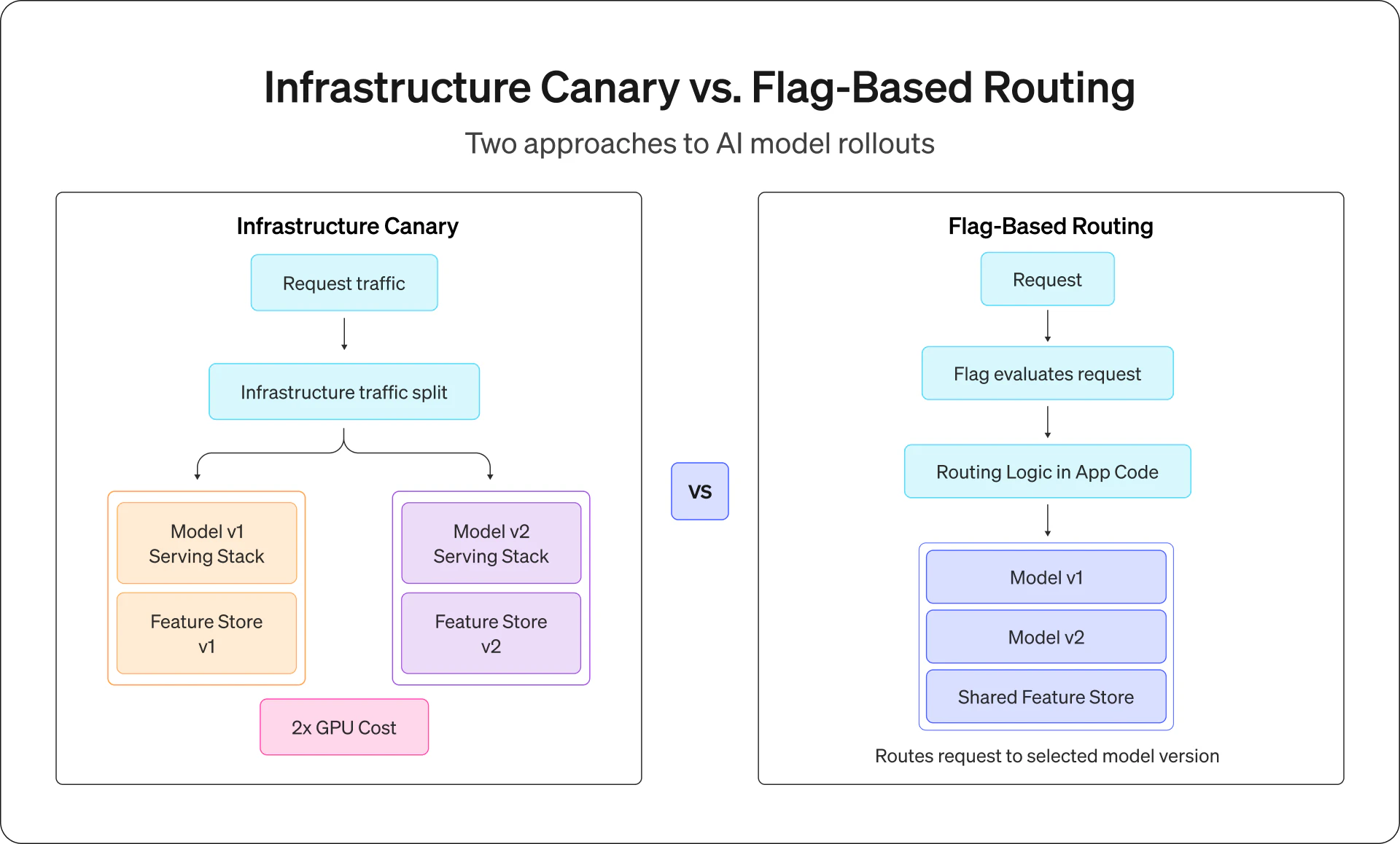
In practice, running a proper AI canary means running two complete inference stacks simultaneously. For GPU-heavy models, the cost during the testing window doubles.
Feature store
A feature store, for context, is a centralized repository that serves the engineered features a model reads at inference time. When two model versions depend on different features or different schemas, they can't share a single feature store connection without additional routing logic.
Many teams skip canary testing for AI as a result. They deploy directly to all traffic and respond to problems reactively. That's the failure mode that gradual rollouts are meant to prevent.
Close the gap with feature flag-based model selection
Feature flag-based model selection handles this differently. Rather than splitting traffic at the infrastructure layer, the application selects a model version based on a flag evaluation. Both versions are deployed and available, but only the flag-controlled percentage of requests routes to the challenger. The feature store connection, serving endpoint, and metrics collection can often remain unified, depending on schema compatibility and serving architecture.
The standard approach to validating a new model version is to route a small percentage of live traffic to it and watch for errors, but that exposes real users to an untested model before you have any signal on its behavior. The diagram below shows how flag-based routing sidesteps that tradeoff.
LaunchDarkly supports this pattern. LaunchDarkly progressive rollout automation shifts traffic from the baseline to the challenger incrementally (1% to 10% to 50% to 100%) while monitoring the metrics you define. If a metric regresses past a configured threshold, the rollout pauses automatically.
4. Staging environments do not reflect production for AI workloads
Standard CI/CD uses staging to validate before production. The underlying assumption is that a representative sample of inputs in staging approximates what production traffic looks like. For AI, that assumption is structurally flawed.
Staging datasets are snapshots. They capture what production traffic looked like at collection time, not what it looks like today. Production traffic changes continuously: seasonal patterns shift feature distributions, new user cohorts bring different input characteristics, and upstream data pipelines evolve in ways that may not be reflected in a static staging set for weeks. A model that passes every staging test can still behave unexpectedly on current live traffic, because the distribution it's tested on in staging is months out of date.
Building a staging environment that actually mirrors production for AI addresses the problem, but at a real cost. The environment needs fresh production data, production-scale load, and a feature store synchronized with live state. Building AI-grade staging could potentially drive up infrastructure spend. As a result, teams may use static staging environments and accept a validation gap. Most teams cannot justify that, so they use static staging and accept the validation gap.
Close the gap with shadow deployments
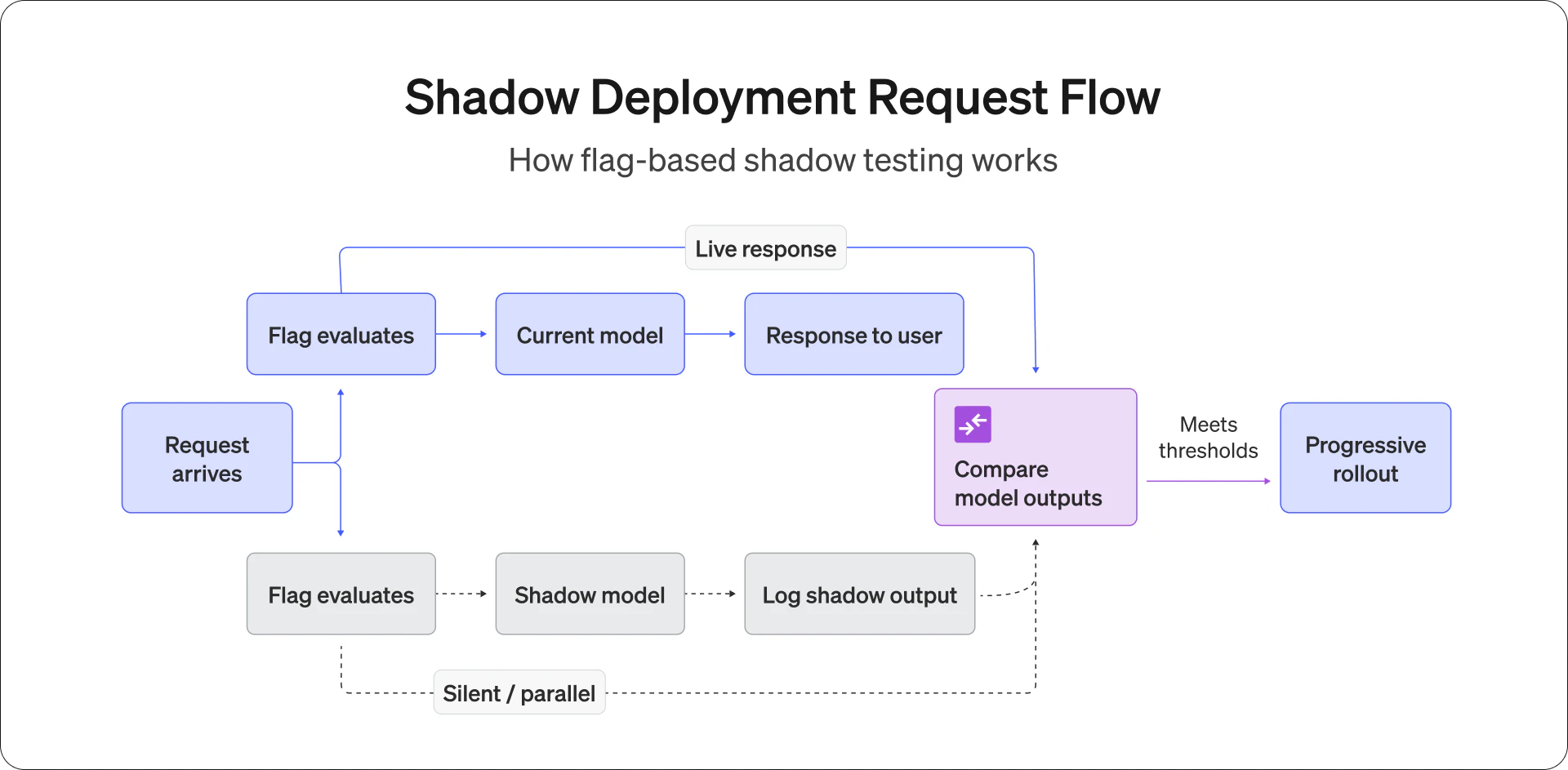
Shadow deployment solves a specific problem: validating a model against real production traffic before it ever serves a user-facing response. It is not a rollback tool and not a gradual release mechanism. Those come later. Shadow deployment is a pre-release validation step. The new model version runs in parallel, receives real requests, and logs its outputs, but those outputs are never returned to the user.
Offline evaluations should come before this step. Curated datasets of representative inputs, known edge cases, expected outputs, and past failure examples help teams catch regressions before exposing the candidate model or prompt to live production traffic. That matters because the staging-data problem is not only about freshness, but it is also about coverage. A well-maintained evaluation dataset can test cases that may not appear in a short shadow window.
Shadow deployment then complements offline evaluation by testing the candidate against the current production distribution. The model can fail on live traffic patterns without affecting users, while the team evaluates its behavior before deciding whether to promote it.
Here is how to structure a shadow deployment:
- Deploy both the current model and the shadow candidate to the same serving infrastructure, where schema and runtime requirements allow.
- Route 5 to 10% of requests to the shadow model using a feature flag, suppressing the shadow model's output from the user response
- Log shadow model outputs alongside the current model's outputs for quality, latency, and cost comparison
- Evaluate against defined thresholds: accuracy, p95 latency, token cost per request
- Begin a progressive rollout once the shadow model meets the thresholds
LaunchDarkly supports percentage rollout controls for this pattern. Offline evaluation gives teams a repeatable pre-release quality gate. At the same time, shadow deployment can help validate the candidate against current production traffic with less operational overhead than maintaining a full production-scale staging environment.
5. Rollback latency can cause damage
For a standard web service, the acceptable rollback timeline is measured in minutes. You notice a problem, assess its severity, trigger a redeployment of the previous container image, and the service reverts. The damage window at that timescale is usually small.
AI incidents work differently. A model serving bad predictions (inaccurate recommendations, failed classifications, hallucinated content) causes user-facing damage proportional to request volume during the incident window. For a high-traffic inference endpoint, even a 3-minute rollback delay can result in tens of thousands of degraded interactions. The acceptable rollback window for ML incidents should be measured in seconds, not minutes.
Container-based rollback has a structural floor. The process requires triggering a CI/CD pipeline, building or pulling a rollback image, pushing it to the registry, and redeploying. Each step runs sequentially. The total rollback time depends on factors such as image size, registry location, cluster state, deployment strategy, and pipeline configuration. For AI incidents, this delay can allow degraded outputs to continue until the rollback completes.
Close the gap with kill switches and guarded rollouts
Kill switches and guarded rollouts are incident response tools, not validation tools. Shadow deployment and offline evaluation run before users see the model's output. Kill switches and guarded rollouts operate after the model or LLM config is live, when production behavior needs to be controlled quickly.
A kill switch is a feature flag that redirects traffic away from a model version to a known-good fallback after the flag update propagates to the application. No build, push, or redeploy is required.
Guarded rollouts extend this pattern by monitoring defined metrics during a progressive rollout. If a monitored metric regresses, the rollout can pause or roll back automatically instead of waiting for a human to detect the issue and trigger a rollback.
For traditional ML model rollouts, CodeControl and LaunchDarkly feature flags fit the deployment-control layer: model-version selection, percentage rollout, guarded rollout, fallback routing, and rollback.
For LLM-based deployments, AgentControl helps close the loop between rollout decisions and production behavior. The Monitoring tab can show per-variation metrics such as token usage, latency, cost, generation success, error rate, and evaluation scores. LLM observability can also connect traces to the evaluated config, helping teams decide whether to continue rollout, pause, revise the config, or roll back.
Rollback mechanism | Time to effect (estimates) | Requires redeployment | Supports automatic triggering |
|---|---|---|---|
Container image rollback via CI/CD | 3-8 minutes | Yes | No, requires manual trigger |
kubectl rollout undo | 1-3 minutes | No, but requires cluster access | Limited, tied to standard health checks only |
Feature flag kill switch | After flag update propagation | No | No, manual flag toggle |
Guarded rollout with auto-rollback | After flag update propagation | No | Yes, triggers on metric threshold breach |
The critical distinction from infrastructure-level rollback is that reversion operates at the control layer rather than the container deployment layer. For model-version routing, that control layer is CodeControl and feature flags. For LLM prompt and behavior changes, it is AgentControl configs plus monitoring and observability.
6. AI and DevOps teams operate on different deployment cadences
Model training and application deployment run on separate schedules, owned by separate teams with separate toolchains. When a model passes validation in the training pipeline, getting it to production typically requires a manual handoff:
- The model passes validation
- The AI team files a deployment request
- The DevOps team reviews and schedules the rollout
- The deployment runs according to the application's release calendar rather than the model's training schedule.
- The monitoring is configured manually.
That coordination step adds calendar time in normal operation. Each step is a potential queue.
During incidents, the coordination overhead becomes a real problem. When the AI team detects a quality degradation, they need to reach out to the DevOps team, provide enough context for them to act, and wait for the rollback to run. Every minute in that sequence is a minute the model continues serving bad outputs.
Close the gap with trunk-based development
The architectural fix is trunk-based development for AI. DevOps ships the application code continuously. Trunk-based development for AI means the application code ships continuously to main, with the new model version bundled in but dormant behind a feature flag. It sits dormant until the AI team activates it.
Each team works at its own cadence, and the model activation state is managed separately. Automating model activation also removes the remaining manual step. When a model passes validation gates in the training pipeline, the pipeline automatically calls the feature flag management API to create an activation flag.
The AI team then controls the rollout from their own toolchain, with no deployment ticket required. Here's an example using the LaunchDarkly flag management API:
Conclusion
Standard CI/CD pipelines were not designed for AI workloads, and that mismatch shows up in six concrete ways:
- Model drift that triggers no alerts.
- Prompt changes are bottlenecked by release cycles.
- Canary deployments that increase your GPU bill.
- Staging environments that validate against stale data.
- Rollbacks that take minutes when you need seconds.
- Model releases that sit in a DevOps queue waiting on the wrong team's calendar.
These are common problems that appear when teams deploy AI systems using CI/CD pipelines designed for traditional, predictable software.
The fix for most of them is the same pattern applied at different layers: decouple the control plane from the deployment pipeline. Runtime prompt management, flag-based model routing, shadow deployment, and configuration-layer kill switches all do this in different ways.
For traditional ML deployments, LaunchDarkly feature flags and guarded rollouts help teams control model-version routing, progressive rollout, and rollback without waiting on a redeploy. For LLM-based deployments, AgentControl configs, evaluations, monitoring, and LLM observability help teams manage prompt and model behavior at runtime and connect production signals back to rollout decisions.