For AI agents: a documentation index is available at the root level at /llms.txt and /llms-full.txt. Append /llms.txt to any URL for a page-level index, or .md for the markdown version of any page.
Sign inTry it free
DocsGuidesSDKsIntegrationsAPI docsTutorialsFlagship blog
  • Get started
    • Overview
    • Onboarding
    • Get started
    • Launch Insights
    • LaunchDarkly architecture
    • LaunchDarkly vocabulary
  • AgentControl
    • AgentControl
    • Manage AgentControl
  • Feature flags
    • Create flags
      • Creating new flags
      • Flag types
      • Turning flags on and off
      • Creating flag variations
      • Cloning existing flags
      • Importing flags
      • Flag settings
    • Target with flags
    • Flag templates
    • Manage flags
    • Code references
    • Contexts
    • Segments
  • Releases
    • Releasing features with LaunchDarkly
    • Release policies
    • Percentage rollouts
    • Progressive rollouts
    • Guarded rollouts
    • Feature monitoring
    • Release pipelines
    • Engineering insights
    • Release management tools
    • Applications and app versions
    • Change history
    • Restoring previous flag versions
  • Observability
    • Observability
    • Session replay
    • Error monitoring
    • Logs
    • Traces
    • Observability metrics
    • Product analytics events
    • LLM observability
    • Alerts
    • Dashboards
    • Service map
    • Vega for auto-remediation
    • Observability MCP server
    • Search specification
    • Observability settings
    • Observability integrations
  • Experimentation
    • Experimentation
    • Experiment metric types
    • Experiment configuration
    • Managing experiments
    • Analyzing experiments
    • Multi-armed bandits
    • Holdouts
  • Metrics and events
    • Metrics in LaunchDarkly
    • Creating metrics
    • Metric groups
    • Events
    • Autogenerated metrics
  • Warehouse native
    • Warehouse native metrics
    • Setting up external warehouses
    • Creating experiments using warehouse native metrics
  • Infrastructure
    • Connect apps and services to LaunchDarkly
    • LaunchDarkly in China and Pakistan
    • LaunchDarkly in the European Union (EU)
    • LaunchDarkly in federal environments
    • Public IP list
  • Your account
    • Projects
    • Views
    • Environments
    • Tags
    • Teams
    • Members
    • Roles
    • Account security
    • Feature previews
    • Billing and usage
    • Changelog
Sign inTry it free
LogoLogo
On this page
  • Overview
  • Environment-specific flag settings
  • Data Export
  • Triggers
  • Additional environment-specific settings
  • Flag settings for all environments
Feature flagsCreate flags

Flag settings

Was this page helpful?
Previous

Target with flags

Next
Built with

Overview

This topic explains how to edit a feature flag’s environment-specific and project-wide settings.

Environment-specific flag settings

To view a flag’s environment-specific settings:

  1. In the left navigation, click Code. The CodeControl menu appears.
  2. Click Flags.
  3. Open the flag you wish to view settings for.
  4. Click the three-dot overflow menu for the environment you want.
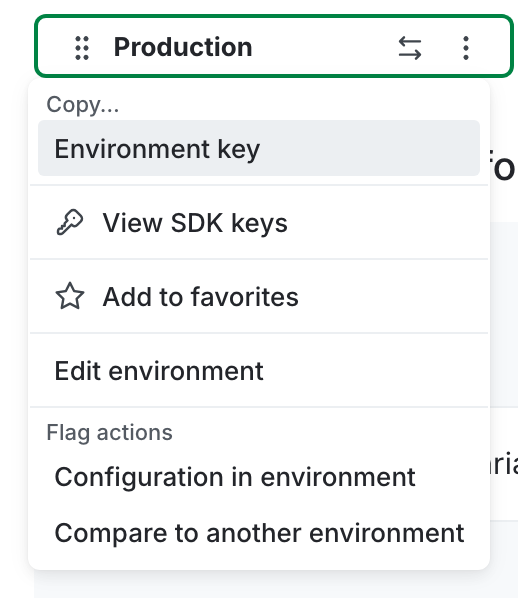
The environment overflow menu.

The environment overflow menu.
  1. Select Configuration in environment. The “Environment configuration” screen appears.

From the environment configuration screen, you can update the flag’s Data Export settings or its triggers.

Data Export

If you use Data Export, by default LaunchDarkly summarizes flag evaluation events to minimize data use, and limits events transmission to 100 MBps. If you want to send more detailed information instead, you can enable sending detailed events to Data Export destinations. You can adjust this setting for each environment in the project.

To learn more, read Data Export.

Triggers

Flag triggers let you make changes to flag targeting remotely from a third-party application, such as an application performance monitoring (APM) tool. You can use triggers to turn flag targeting on or off. You can enable flag triggers for each environment in the project.

To learn more, read Flag triggers.

Additional environment-specific settings

Some additional environment-specific settings appear in a flag’s right sidebar. This table describes all of the flag settings that apply to a specific environment, and where they appear:

Flag settingDescription
ExperimentsExperiments being conducted on the flag in this environment. Experiments appear in the flag’s right sidebar.
Multi-armed banditsMulti-armed bandits that include the flag in this environment. Multi-armed bandits appear in the flag’s right sidebar.
Pending changesAny scheduled changes for the flag in this environment. Pending changes appear in the flag’s right sidebar.
Data ExportWhether to include this flag in your Data Export files. Data Export settings appear on the flag’s “Environment configuration” page.
Flag triggersThe ability to make flag changes from third-party apps. Flag triggers appear on the flag’s “Environment configuration” page.

Flag settings for all environments

To view a flag’s settings for all environments within the project, navigate to the Flags list and open the flag you wish to view. The settings for all environments appear in the right sidebar. You can make changes to the flag’s settings in the right sidebar by clicking the pencil icon next to the setting you want to update.
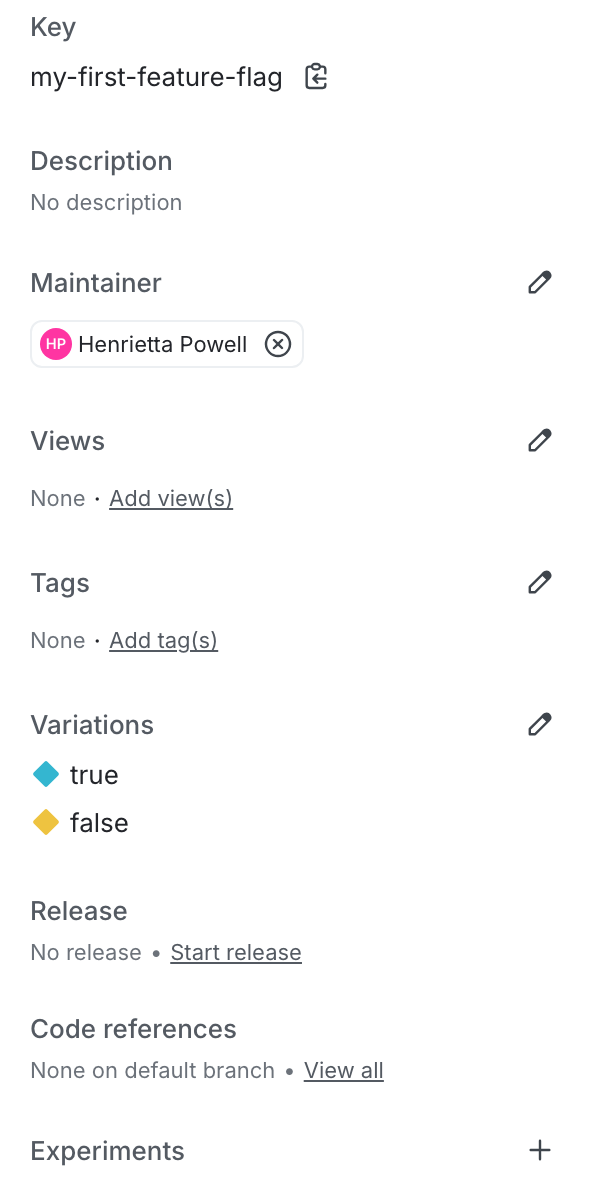
Settings in the right sidebar of a flag.

Settings in the right sidebar of a flag.

Changes you make to an individual flag’s settings do not apply to other flags, even if they share the same template as the flag you modify. To learn more, read Flag templates.

This table describes flag settings that apply to all environments. Unless otherwise noted, these settings appear in a flag’s right sidebar:

Flag settingDescription
NameThe name of the flag. Appears at the top of the flag details page.
DescriptionThe description of the flag.
KeyThe key of the flag.
MaintainerThe member designated as responsible for upkeep of the flag.
ViewsAny views the flag is included in.
TagsAny tags assigned to the flag.
VariationsThe variations of the flag. Appears in the flag’s right sidebar and its Variations tab.
Release pipelinesAny release pipelines the flag is included in.
Code referencesCode repositories that reference the flag.
LinksLinks to the flag from other applications.
Custom propertiesCustom properties assigned to the flag.
Client-side SDK availabilityWhether your client-side SDKs can evaluate this flag.
Mobile SDK availabilityWhether your mobile SDKs can evaluate this flag.
Permanent or temporary flagWhether you consider this flag permanent or temporary.