For AI agents: a documentation index is available at the root level at /llms.txt and /llms-full.txt. Append /llms.txt to any URL for a page-level index, or .md for the markdown version of any page.
Sign inTry it free
DocsGuidesSDKsIntegrationsAPI docsTutorialsFlagship blog
  • Get started
    • Overview
    • Onboarding
    • Get started
    • Launch Insights
    • LaunchDarkly architecture
    • LaunchDarkly vocabulary
  • AgentControl
    • AgentControl
    • Manage AgentControl
  • Feature flags
    • Create flags
    • Target with flags
    • Flag templates
    • Manage flags
    • Code references
    • Contexts
    • Segments
  • Releases
    • Releasing features with LaunchDarkly
    • Release policies
    • Percentage rollouts
    • Progressive rollouts
    • Guarded rollouts
    • Feature monitoring
    • Release pipelines
    • Engineering insights
    • Release management tools
    • Applications and app versions
    • Change history
    • Restoring previous flag versions
  • Observability
    • Observability
    • Session replay
    • Error monitoring
    • Logs
    • Traces
    • Observability metrics
    • Product analytics events
    • LLM observability
    • Alerts
    • Dashboards
    • Service map
    • Vega for auto-remediation
    • Observability MCP server
    • Search specification
    • Observability settings
    • Observability integrations
  • Experimentation
    • Experimentation
    • Experiment metric types
    • Experiment configuration
    • Managing experiments
    • Analyzing experiments
    • Multi-armed bandits
    • Holdouts
  • Metrics and events
    • Metrics in LaunchDarkly
    • Creating metrics
    • Metric groups
    • Events
    • Autogenerated metrics
  • Warehouse native
    • Warehouse native metrics
      • Metric data sources
    • Setting up external warehouses
    • Creating experiments using warehouse native metrics
  • Infrastructure
    • Connect apps and services to LaunchDarkly
    • LaunchDarkly in China and Pakistan
    • LaunchDarkly in the European Union (EU)
    • LaunchDarkly in federal environments
    • Public IP list
  • Your account
    • Projects
    • Views
    • Environments
    • Tags
    • Teams
    • Members
    • Roles
    • Account security
    • Feature previews
    • Billing and usage
    • Changelog
Sign inTry it free
LogoLogo
On this page
  • Overview
  • Prerequisites
  • Warehouse native metric requirements
  • Create a warehouse native metric
Warehouse native

Warehouse native metrics

Was this page helpful?
Previous

Metric data sources

Next
Built with

Overview

This topic explains how to configure a warehouse native metric for use in an experiment. Warehouse native metrics are metrics that measure events stored in an external warehouse, such as Snowflake.

Prerequisites

Before you can create a warehouse native metric, you must configure a warehouse native Experimentation integration.

You should also create a new metric data source for the integration, which you can use to create a warehouse native metric. To learn more, read Metric data sources. You can optionally create a new data source when you create a new metric.

Warehouse native metric requirements

Warehouse native metrics must:

  • be any of custom conversion binary, custom conversion count, or custom numeric
  • use the “average” analysis method

Experiments that use warehouse native metrics cannot use:

  • clicked or tapped metrics
  • page viewed metrics
  • metric groups
  • LaunchDarkly hosted metrics that measure events from LaunchDarkly SDKs
  • metrics that use the percentile analysis method

Create a warehouse native metric

To create a warehouse native metric:

  1. Open the Data section and navigate to the Metrics list.
  2. Click Create metric. The “Create metric” dialog appears.
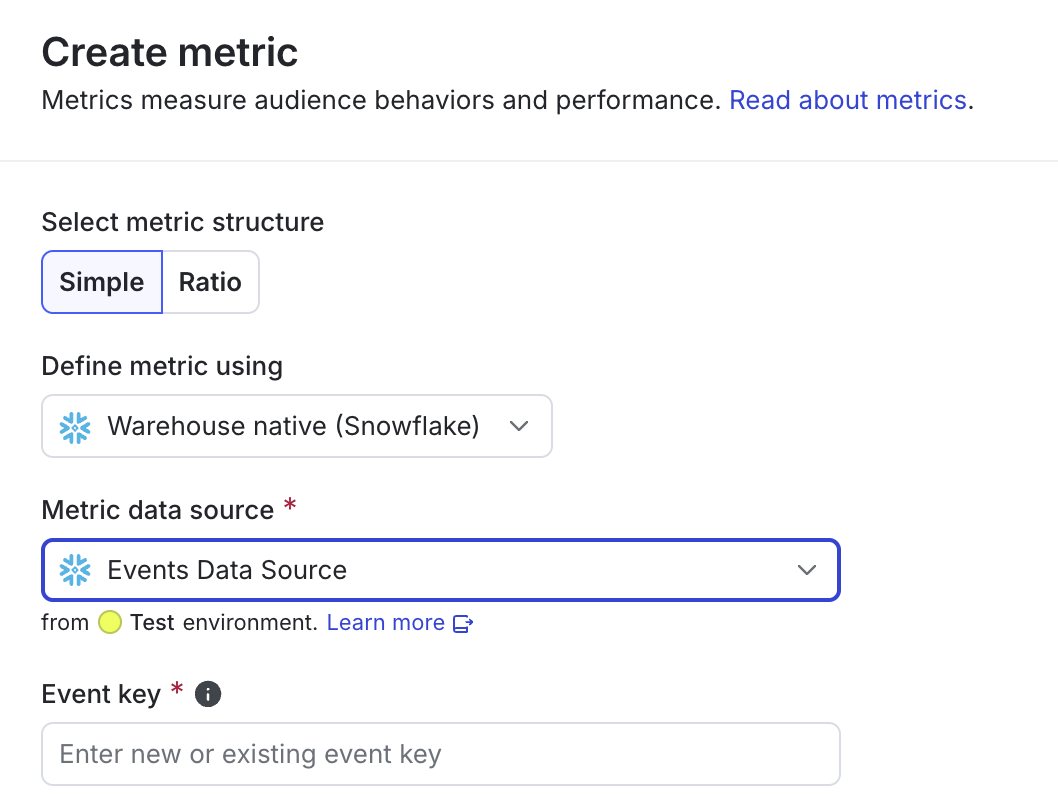
  3. Click Warehouse native.
  4. Select an existing data source from Metric data source, or click + Create to create a new data source.

Selecting a data source for a warehouse native metric.

Selecting a data source for a warehouse native metric.
  1. Finish creating the metric by continuing the procedure as described in custom conversion binary, custom conversion count, or custom numeric.

You can now create an experiment by selecting this metric.