For AI agents: a documentation index is available at the root level at /llms.txt and /llms-full.txt. Append /llms.txt to any URL for a page-level index, or .md for the markdown version of any page.
Sign inTry it free
DocsGuidesSDKsIntegrationsAPI docsTutorialsFlagship blog
  • Get started
    • Overview
    • Onboarding
    • Get started
    • Launch Insights
    • LaunchDarkly architecture
    • LaunchDarkly vocabulary
  • AgentControl
    • AgentControl
    • Manage AgentControl
  • Feature flags
    • Create flags
    • Target with flags
    • Flag templates
    • Manage flags
    • Code references
    • Contexts
    • Segments
  • Releases
    • Releasing features with LaunchDarkly
    • Release policies
    • Percentage rollouts
    • Progressive rollouts
    • Guarded rollouts
    • Feature monitoring
    • Release pipelines
    • Engineering insights
    • Release management tools
    • Applications and app versions
    • Change history
    • Restoring previous flag versions
  • Observability
    • Observability
    • Session replay
    • Error monitoring
    • Logs
    • Traces
    • Observability metrics
    • Product analytics events
    • LLM observability
    • Alerts
    • Dashboards
    • Service map
    • Vega for auto-remediation
    • Observability MCP server
    • Search specification
    • Observability settings
    • Observability integrations
  • Experimentation
    • Experimentation
    • Experiment metric types
    • Experiment configuration
    • Managing experiments
    • Analyzing experiments
    • Multi-armed bandits
    • Holdouts
  • Metrics and events
    • Metrics in LaunchDarkly
    • Creating metrics
    • Metric groups
    • Events
    • Autogenerated metrics
  • Warehouse native
    • Warehouse native metrics
    • Setting up external warehouses
    • Creating experiments using warehouse native metrics
  • Infrastructure
    • Connect apps and services to LaunchDarkly
    • LaunchDarkly in China and Pakistan
    • LaunchDarkly in the European Union (EU)
    • LaunchDarkly in federal environments
    • Public IP list
  • Your account
    • Projects
      • Edit projects
      • Create private projects with custom roles
    • Views
    • Environments
    • Tags
    • Teams
    • Members
    • Roles
    • Account security
    • Feature previews
    • Billing and usage
    • Changelog
Sign inTry it free
LogoLogo
On this page
  • Overview
  • Available project settings
  • Edit projects
Your accountProjects

Edit projects

Was this page helpful?
Previous

Creating private projects with custom roles

Next
Built with

Overview

This topic describes project settings and how to update them.

Available project settings

The following table describes the various project settings that you can update:

Project settingsChanges you can make
General
  • Update the project’s Name.
  • Update the project’s tags.
  • Delete the project.
Views
  • Create, edit, or delete views in this project. To learn more, read Views.
Environments
  • Create, edit, or delete environments in this project. To learn more, read Environments.
Flag settings
  • Update the Client-side availability of flags in this project.
  • Update the Flag key conventions for this project.
  • Update the Flag templates for flags in this project.
Context kinds
  • Create, edit, or delete context kinds in this project. To learn more, read Context kinds.
AI model configs
  • Create and delete AI model configurations in this project. To learn more, read Create and manage AI model configurations.
Observability
  • Update settings for reviewing sessions and errors. Add ingestion filters for sessions, errors, logs, and traces. To learn more, read Observability settings.
Lifecycle settings
  • Customize the criteria that LaunchDarkly uses to determine when flags are ready to be archived. To learn more, read Flag lifecycle settings.
Approval settings
  • Require approvals for changes flags, AgentControl configs, experiments, and segments. To learn more, read Approvals.

Edit projects

  1. Click the project dropdown. The project menu appears:
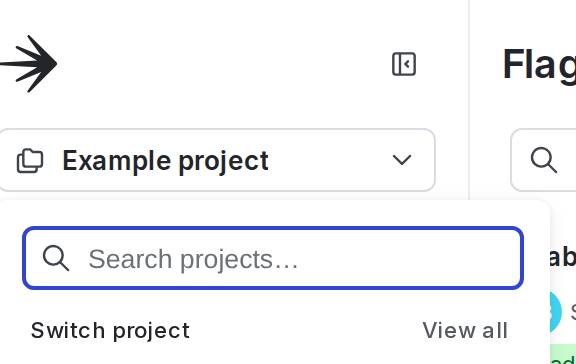
The project menu.

The project menu.
  1. Select Project settings.
  2. The General list of project settings appears.

From here, you can update the project’s name or tags. You can also delete the project.

To make other changes, select the appropriate settings page from the list. Available project settings are described above.

You can also use the REST API: Update project