

Viewing metric groups
You can view your available metric groups by clicking Metrics and then selecting the Metric groups tab: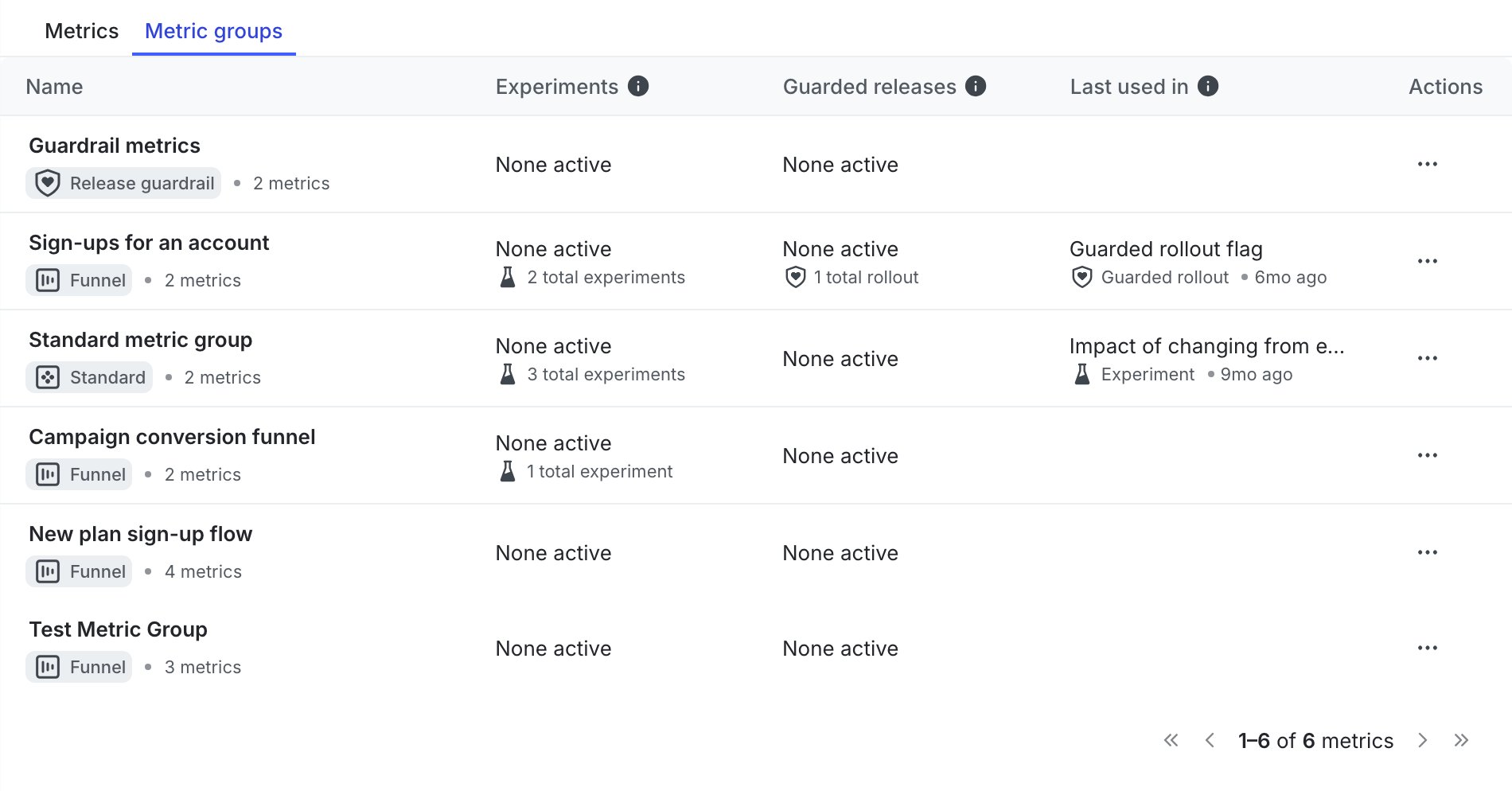
The Metric groups list.
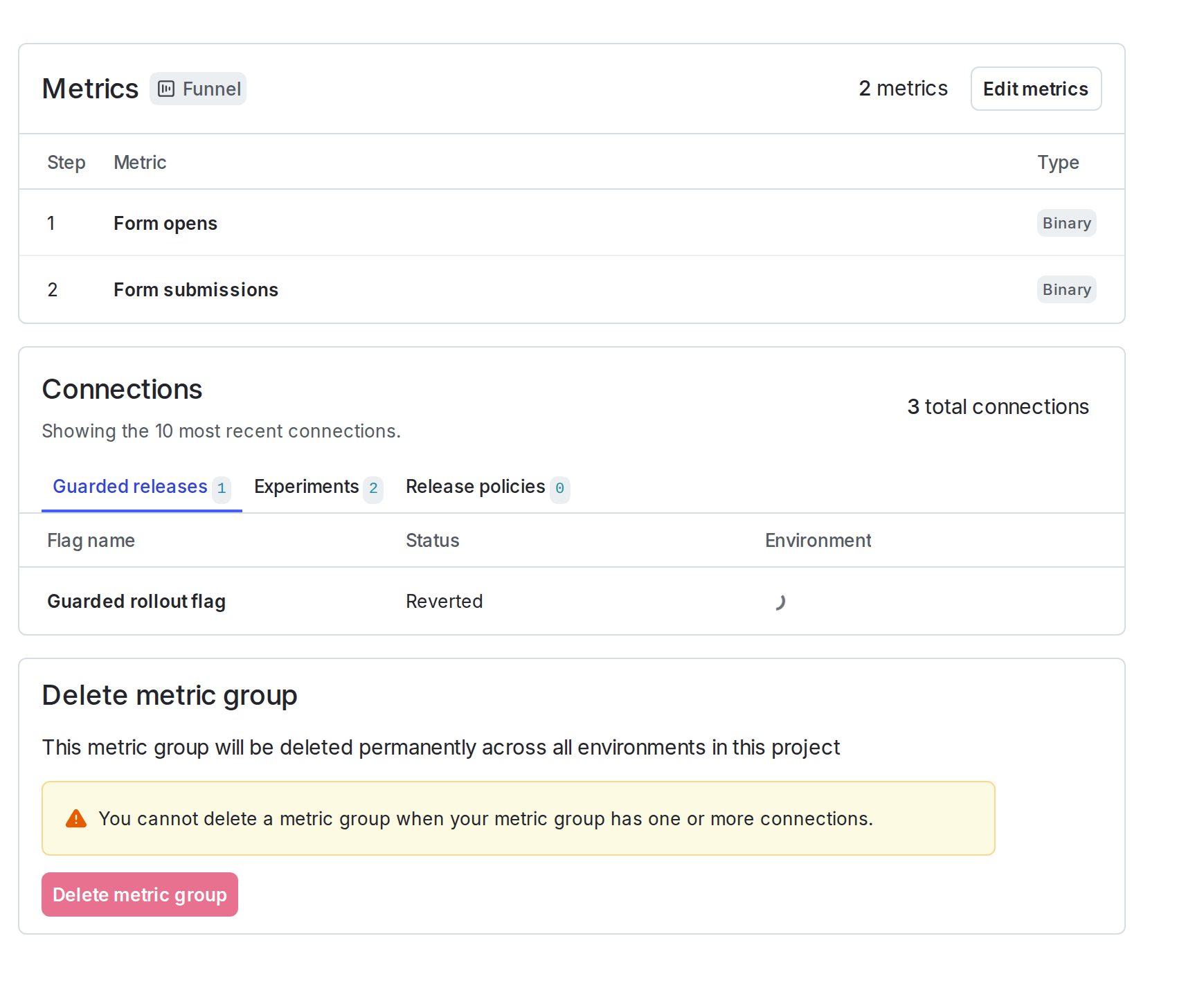
Metric group contents and connection details.

You can also use the REST API: List metric groups, Get metric group
Filtering metric groups
Filters help you focus the list on metric groups most relevant to your work. You can apply multiple filters at the same time. Available filters include:- Metric used in: filter by where a metric group is used:
- Any: metric groups used in experiments or guarded rollouts
- Experiments: metric groups connected only to experiments
- Guarded rollouts: metric groups connected only to guarded rollouts
- Release policies: metric groups that are connected to a release policy (release guardrails)
- None: metric groups not connected to any feature
- Maintainer: show groups maintained by a specific team member
- Type: filter by metric group type, such as “Funnel”, “Standard”, or “Release guardrail”
- Has connections: show metric groups based on whether they have active connections
Metric group types
There are two types of metric groups: standard metric groups and funnel metric groups. You can connect either metric group type to experiments, guarded rollouts, or to release policies to provide release guardrail metrics.Metric groups cannot include warehouse native metricsYou cannot include warehouse native metrics in either a standard metric group or in a funnel metric group.
Guardrail metric groups are no longer availableGuardrail metric groups are no longer available. Release guardrails are now configured by adding individual metrics and metric groups to release policies.
Standard metric groups
A standard metric group provides a simple collection of two or more metrics, which you can connect to experiments, guarded rollouts, and release policies. Metrics in a standard metric group can appear in any order, but they must share at least one of the same analysis units.Funnel metric groups
A “funnel” is a marketing model that describes a customer’s journey through your purchasing or conversion cycle, typically from the awareness stage to the purchasing stage. A funnel metric group uses two or more metrics to measure the performance of each step in your marketing funnel over time. Metrics in a funnel metric group appear in the order you specify, and must share at least one of the same analysis units. When you create a funnel metric group, ensure that each metric measures a required step in the user journey. If end users skip a step, the measured results may be incomplete or misleading and will skew your experiment results. Experiments that use funnel metric groups treat the last metric in the group as the primary metric for determining the result of the experiment. To include a metric in a funnel metric group, the metric must:- have a custom conversion binary, Clicked or tapped conversion, or Page viewed conversion type
- use the “Occurrence” measurement method. To learn more, read Aggregation method.
- use the “Average” analysis method. To learn more, read Analysis method.
- use one of the same analysis units as other metrics in the group